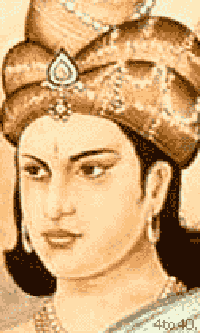
Asoka

19/05/201112:28(Xem: 15357)
Asoka
asoka-01
Asoka, grandson of Chandragupta, was one of the first royal patrons of Buddhism. The first was, perhaps, Bimbisara, who lived at the time of the Buddha. Asoka's legend is recorded in a second century book called the "Asokavadana" which was translated into Chinese by Fa-ch'in in 300 A.D. He is also known from his edicts written on rocks and pillars throughout India.

In his youth. Asoka was known as Canda Asoka, the fierce Asoka, due to his aggressive nature. As a prince, he was appointed governor of Vidisa (modern Bhilsa) where he married a rich merchant's daughter. On hearing of his father's impending death, he hurried to the Capital, Pataliputra, where, after occupying it, he killed all of the rival princes with the exception of his own brother. This brutality met with the opposition of the populace, delaying his coronation for four years. He ascended to the throne in 270 B.C. Eight years into his reign, he invaded Kalinga (modern Orissa) killing many thousands of people in battle whilst many thousands died from the effects of the war.

This was the turning point of his life. He halted his military campaigns and, being a Buddhist, he focused his attention instead to religious conquests, known as Dharmavijaya. He appointed his officers to tour the country on religious missions. After twenty years of his reign, he visited the Buddha's birthplace at Lumbini in modern Nepal, where he erected a pillar recording his visit. He also visited Bodh Gaya, where the Buddha attained Enlightenment, as well as Sarnath, where the Buddha preached his first sermon. It was here that he erected a pillar threatening excommunication to any monk who caused a schism in the Sangha. He abandoned meat eating for himself and advocated moral values for his subjects. He also promoted tolerance towards all religions which he supported financially.

The prevalent religions of that time were the sramanas or wandering ascetics, Brahmins, Ajivakas and Jains. He recommended that all religions desist from self praise and condemnation of others. His pronouncements were written on rocks at the periphery of his kingdom and on pillars along the main roads and where pilgims gathered. He also established many hospitals for both humans and animals At one stage, he conferred many gifts on the Buddhist Sangha which resulted in the attraction to its ranks of non-Buddhist hangers-on and disreputable people looking for an easier life. This resulted in a degeneration, and lack of purity in the Sangha. He decided to rectify this problem by convening a Sangha Council at Pataliputra to determine the true nature of Dharma practice and to banish those who would not adhere to it.

Following this Council, he decided to extend his missions to other countries, which included the Ionian Greeks, Ghandar, Kashmir, the Himalayan Regions, Mysore. Ceylon. Burma, Malaya and Sumatra. He sent his son, Mahendra, and his daughter Sanghamitra to Ceylon and their visit is celebrated in Sri Lanka by public holidays to this day. His 13th Rock Edict records that he tried to spread Buddhism to the kingdoms of Antiochus II, King of Syria, Ptolemy of Egypt, Antigonos of Macedonia, Alexander of Epirus (Northern Greece) and Magas in Cyrenia (North Africa). What a difference modern history may have been had he succeeded. Under Asoka, nearly the whole of the Indian Continent was unified for the first time in history. Dharma meant for Asoka morality, active social concern, religious tolerance, ecological awareness, observance of ethical precepts and renunciation of war.
Gửi ý kiến của bạn
Tắt
Telex
VNI
Tên của bạn
Email của bạn
09/09/2019(Xem: 19280)
A yellow-colored Buddhist temple adorned with flags and golden dragons on its pointed roofs in a quiet town outside Tokyo presents a stark contrast to the typically somber-looking Buddhist places of worship usually found in rural Japan. But the steady stream of out-of-town weekend visitors and their nationality also set it apart, for the temple was built by and serves members of the large Vietnamese community in the Tokyo metropolitan area.
01/05/2019(Xem: 6016)
Dalai Lama says he could be reincarnated in India, but Beijing says rebirth must follow Chinese rules, The Dalai Lama has warned there could be two reincarnations of Tibetan Buddhism's highest spiritual leader following his death, and that a candidate chosen by communist China was not to be trusted. The comment has prompted Beijing to say the reincarnation "must comply with Chinese laws and regulations". The 14th Dalai Lama, who fled Tibet for India 60 years ago to the day last Sunday disguised as a soldier, said he expected his reincarnated being to be discovered in India this time around.
11/12/2018(Xem: 10232)
Noble Doctrine Thoughts_Ven Bopitiye Sumanavansa Thero_Translated by Dr Devananda
13/09/2018(Xem: 8604)
Most Venerable Thich Nhu Dien has been a member of the Buddhist order for 55 years, passed on the Vietnamese Lam Te School in Germany and authored of over 60 books: The Vietnamese monk ThíchNhưĐiển is one of the most important representatives of Buddhism in Germany; at the same time he is a co-designer of Vietnamese integration in this country. An essay on the life and work of a Vietnamese Dharma Master on behalf of his 70th birthday.
13/06/2018(Xem: 15520)
Nirvana Is Eternal Peace, “Nirvana Is Eternal Peace”, four words on the banner on Quang Duc Buddhist Homepage about the funeral of the Most Venerable Thich Nhu Hue, as congratulations to His Holiness on the path to the Buddh “Nirvana Is Eternal Peace”, four words on the banner on Quang Duc Buddhist Homepage about the funeral of the Most Venerable Thich Nhu Hue, as congratulations to His Holiness on the path to the Buddhahood end of June, 2016. In the Saha World, death means grieves but in Buddhism, death can be a joy (Nirvana Is Eternal Peace), is it and contrary difficult to understand? That’s why Buddhism appears, that is to deal with this contrary. That is to radically remove the roots of birth and death cycle. If there is still birth and death, there is still suffering. No birth no death means happiness or bliss, it is simply so. In the Great Nirvana Sutra, the Buddha declares:“All formations are impermanent. They have birth and death. Birth and death ends, then comes Nir
22/05/2018(Xem: 60753)
The Buddhist community is extremely upset by the inappropriate and disrespectful use of the image of Buddha, The Buddhist community is extremely upset by the inappropriate and disrespectful use of the image of Buddha, in a display at the National Gallery of Victoria (NGV) entitled the 'Eternity-Buddha in Nirvana, the Dying Gaul, Farnese Hercules, Night, Day, Sartyr and Bacchante, Funerary Genius, Achilles, Persian Soldier Fighting, Dancing Faun, Crouching Aphrodite, Narcisse Couché, Othryades the Spartan Dying, the Fall of Icarus, A River, Milo of Croton'. It can also be seen at: https://www.ngv.vic.gov.au/explore/collection/work/131149/ Although this display has been in place for some months, we have only just been made aware of its' existence. We are not usually outspoken, but this display desecrates the image of Buddha by placing images of these mythical images on him and in doing so, showing no apparent regard or respect for Him.
14/09/2017(Xem: 8388)
Congratulatory Message on the occasion of the 7th Buddhist Summit Dear Venerables, I am very pleased to know from Ven. Chandaratana in France that the 7th Buddhist Summit will be held in November 2017 in Sri Lanka, one of the leading countries of Theravada Buddhism, for the purpose of exchanging views about the development of Buddhism around the world. I also received the information that the World Buddhist Summit Organization in Japan had undertaken the enormous task to build up a Nalanda Buddhist University in Japan. This is a great act of merit and indeed good news not only for Japanese Buddhists, but also for Buddhists throughout the world. On behalf of the Vietnamese Buddhists in Germany, I would like to take this opportunity to thank you for your great achievements and wish all participants of the 7th Buddhist Summit a successful conference and fruitful discussion. May we, Buddhists from the various traditions, always work together for the benefit of all sentien
12/08/2017(Xem: 18569)
Tibet Dr Lobsang Sangay address to the National Press Club Canberra 8 August 2017 mp4 cba - Dr Lobsang Sangay is the democratically re-elected leader of the Tibetan people and political successor to His Holiness the Dalai Lama of Tibet.
27/03/2017(Xem: 52303)
The Seeker's Glossary of Buddhism By Sutra Translation Committee of USA/Canada This is a revised and expanded edition of The Seeker's Glossary of Buddhism. The text is a compendium of excerpts and quotations from some 350 works by monks, nuns, professors, scholars and other laypersons from nine different countries, in their own words or in translation. The editors have merely organized the material, adding a few connecting thoughts of their own for ease in reading.
26/10/2016(Xem: 42089)
In India in the 6th century BC, Sakyamuni, "a wise man of the Sakya tribe", had been meditating under a tree when, suddenly, he was struck with the comprehension of all things. He became Buddha, meaning the « Illuminated ». His message, based on a pragmatic philosophy, taught how to free oneself from all needs in order to achieve illumination. After the death of the Enlightened One, his disciples – a few monks – began to spread his teachings all over India, from Ceylon to the Himalayan. Fearing man’s penc
