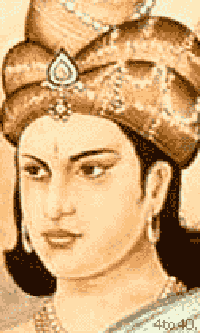
Asoka, grandson of Chandragupta, was one of the first royal patrons of Buddhism. The first was, perhaps, Bimbisara, who lived at the time of the Buddha. Asoka's legend is recorded in a second century book called the "Asokavadana" which was translated into Chinese by Fa-ch'in in 300 A.D. He is also known from his edicts written on rocks and pillars throughout India.
In his youth. Asoka was known as Canda Asoka, the fierce Asoka, due to his aggressive nature. As a prince, he was appointed governor of Vidisa (modern Bhilsa) where he married a rich merchant's daughter. On hearing of his father's impending death, he hurried to the Capital, Pataliputra, where, after occupying it, he killed all of the rival princes with the exception of his own brother. This brutality met with the opposition of the populace, delaying his coronation for four years. He ascended to the throne in 270 B.C. Eight years into his reign, he invaded Kalinga (modern Orissa) killing many thousands of people in battle whilst many thousands died from the effects of the war.
This was the turning point of his life. He halted his military campaigns and, being a Buddhist, he focused his attention instead to religious conquests, known as Dharmavijaya. He appointed his officers to tour the country on religious missions. After twenty years of his reign, he visited the Buddha's birthplace at Lumbini in modern Nepal, where he erected a pillar recording his visit. He also visited Bodh Gaya, where the Buddha attained Enlightenment, as well as Sarnath, where the Buddha preached his first sermon. It was here that he erected a pillar threatening excommunication to any monk who caused a schism in the Sangha. He abandoned meat eating for himself and advocated moral values for his subjects. He also promoted tolerance towards all religions which he supported financially.
The prevalent religions of that time were the sramanas or wandering ascetics, Brahmins, Ajivakas and Jains. He recommended that all religions desist from self praise and condemnation of others. His pronouncements were written on rocks at the periphery of his kingdom and on pillars along the main roads and where pilgims gathered. He also established many hospitals for both humans and animals At one stage, he conferred many gifts on the Buddhist Sangha which resulted in the attraction to its ranks of non-Buddhist hangers-on and disreputable people looking for an easier life. This resulted in a degeneration, and lack of purity in the Sangha. He decided to rectify this problem by convening a Sangha Council at Pataliputra to determine the true nature of Dharma practice and to banish those who would not adhere to it.
Following this Council, he decided to extend his missions to other countries, which included the Ionian Greeks, Ghandar, Kashmir, the Himalayan Regions, Mysore. Ceylon. Burma, Malaya and Sumatra. He sent his son, Mahendra, and his daughter Sanghamitra to Ceylon and their visit is celebrated in Sri Lanka by public holidays to this day. His 13th Rock Edict records that he tried to spread Buddhism to the kingdoms of Antiochus II, King of Syria, Ptolemy of Egypt, Antigonos of Macedonia, Alexander of Epirus (Northern Greece) and Magas in Cyrenia (North Africa). What a difference modern history may have been had he succeeded. Under Asoka, nearly the whole of the Indian Continent was unified for the first time in history. Dharma meant for Asoka morality, active social concern, religious tolerance, ecological awareness, observance of ethical precepts and renunciation of war.
Gửi ý kiến của bạn


%7Cutmcsr%3D(direct)%7Cutmcmd%3D(none)%3B%2B__utmv%3D326209784.-%3B)