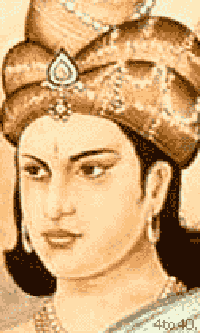
Asoka

19/05/201112:28(Xem: 15355)
Asoka
asoka-01
Asoka, grandson of Chandragupta, was one of the first royal patrons of Buddhism. The first was, perhaps, Bimbisara, who lived at the time of the Buddha. Asoka's legend is recorded in a second century book called the "Asokavadana" which was translated into Chinese by Fa-ch'in in 300 A.D. He is also known from his edicts written on rocks and pillars throughout India.

In his youth. Asoka was known as Canda Asoka, the fierce Asoka, due to his aggressive nature. As a prince, he was appointed governor of Vidisa (modern Bhilsa) where he married a rich merchant's daughter. On hearing of his father's impending death, he hurried to the Capital, Pataliputra, where, after occupying it, he killed all of the rival princes with the exception of his own brother. This brutality met with the opposition of the populace, delaying his coronation for four years. He ascended to the throne in 270 B.C. Eight years into his reign, he invaded Kalinga (modern Orissa) killing many thousands of people in battle whilst many thousands died from the effects of the war.

This was the turning point of his life. He halted his military campaigns and, being a Buddhist, he focused his attention instead to religious conquests, known as Dharmavijaya. He appointed his officers to tour the country on religious missions. After twenty years of his reign, he visited the Buddha's birthplace at Lumbini in modern Nepal, where he erected a pillar recording his visit. He also visited Bodh Gaya, where the Buddha attained Enlightenment, as well as Sarnath, where the Buddha preached his first sermon. It was here that he erected a pillar threatening excommunication to any monk who caused a schism in the Sangha. He abandoned meat eating for himself and advocated moral values for his subjects. He also promoted tolerance towards all religions which he supported financially.

The prevalent religions of that time were the sramanas or wandering ascetics, Brahmins, Ajivakas and Jains. He recommended that all religions desist from self praise and condemnation of others. His pronouncements were written on rocks at the periphery of his kingdom and on pillars along the main roads and where pilgims gathered. He also established many hospitals for both humans and animals At one stage, he conferred many gifts on the Buddhist Sangha which resulted in the attraction to its ranks of non-Buddhist hangers-on and disreputable people looking for an easier life. This resulted in a degeneration, and lack of purity in the Sangha. He decided to rectify this problem by convening a Sangha Council at Pataliputra to determine the true nature of Dharma practice and to banish those who would not adhere to it.

Following this Council, he decided to extend his missions to other countries, which included the Ionian Greeks, Ghandar, Kashmir, the Himalayan Regions, Mysore. Ceylon. Burma, Malaya and Sumatra. He sent his son, Mahendra, and his daughter Sanghamitra to Ceylon and their visit is celebrated in Sri Lanka by public holidays to this day. His 13th Rock Edict records that he tried to spread Buddhism to the kingdoms of Antiochus II, King of Syria, Ptolemy of Egypt, Antigonos of Macedonia, Alexander of Epirus (Northern Greece) and Magas in Cyrenia (North Africa). What a difference modern history may have been had he succeeded. Under Asoka, nearly the whole of the Indian Continent was unified for the first time in history. Dharma meant for Asoka morality, active social concern, religious tolerance, ecological awareness, observance of ethical precepts and renunciation of war.
Gửi ý kiến của bạn
Tắt
Telex
VNI
Tên của bạn
Email của bạn
28/10/2015(Xem: 7240)
On September 13th, Buddhist nun, teacher, and author Pema Chödrön had the opportunity to meet President Barack Obama. There were, as you can see, smiles all around. Below, Glenna Olmsted, Executive Assistant to Pema, tells us about the meeting and how it came to be.
07/06/2015(Xem: 12624)
Happy 80th Birthday to Your Holy Highness, the 14th Dalai Lama Dear Holy Highness, On behalf of the Buddhist members of the Quang Duc Vietnamese Monastery in Victoria, Australia, I would like to thank you for your coming to Australia for this, the tenth time, to bring peace, happiness and your teachings to all of the people in our humble country. You are the manifestation of Avalokiteshvara Bodhisattva, the symbol of the mother of Compassion. Your loving kindness and wise teachings have helped to heal much of the sickness of the world today. We Buddhists, are so proud of you, the one person who has done so much to bring Buddhism to the West. May the Buddha bless you with good health and a long life. May you and your people return to Tibet soon; and May Tibet soon reclaim their independence. We pray that Your Holy Highness enjoys a happy and memorable 80th Birthday. Yours most respectfully, Ven Thich Nguyen Tang
21/04/2015(Xem: 6369)
There had been many changes to Australia since Malcolm Fraser became its 22nd Prime Ministe. During his leadership of 7 years and 4 months (11/11/1975 to 11/03/1983) with the implementation of multi-cultural promotion policies that enhance human rights, compassion and social justice, 56,000 Vietnamese boat people became Australian residents. The number has increased, leading to a community of 300,000 Vietnameses up to now.
13/04/2015(Xem: 12900)
On 26 February 2015 (i.e. the 8th of the 1st lunar month, Ất Mùi year), the renouncing ceremony for Miss Bích Liên was held greatly and repespectfully at Ngọc Vân Temple, Bắc Bình province, Bình Thuận county. Most Venerable Thích Giác Hoằng and Most Venerable Thích Nữ Diệu Liên, the abbess of Ngọc Vân Temple, honorly attended to bless for her. After the teaching from Most Venerable Thích Giác Hoằng, Miss Bích Liên now aka Reverend Thích Nữ Liên Ngọc expressed her good reason to be a nun. Her voice was so emotional and sensitive as she reviewed her reasons for renouncing:
19/12/2014(Xem: 24723)
Lãnh đạo tinh thần của người Tây Tạng, Đức Đạt Lai Lạt Ma, nói với BBC ông cho rằng có thể mình sẽ là người cuối cùng giữ cương vị này. Tuy nhiên ông nói cũng là điều tốt nếu như truyền thống nhiều thế kỷ nay dừng ở "một vị Đạt Lai Lạt Ma được nhiều người tôn kính". Ông cũng cho rằng Anh quốc đã nhẹ tay với Trung Quốc quanh các vụ biểu tình mới đây vì lý do tài chính. Ông nói: "Túi tiền của họ ít nhiều đang trống rỗng, vậy nên họ quan trọng việc quan hệ chặt với Trung Quốc vì lý do tiền bạc". Đức Đạt Lai Lạt Mamới đây đã bị Đức Giáo hoàng từ chối tiếp khi ông tới tham dự một cuộc họp dành cho những người đoạt giải Nobel Hòa bình tại Rome. Vatican giải thích đây là vì "tình hình tế nhị" với Trung Quốc.
11/12/2014(Xem: 6205)
To the south of Los Angeles is a lively independent suburb named Garden Grove. This small city with a population of around 170,000 is home to the Little Saigon of the Los Angeles region, named for the large number of Vietnamese refugees that immigrated there during the 1970s. Garden Grove has long been known as a conservative bastion with a well-run political machine that kept a tight leash on who ran the city. On 4 November by a margin of just 15 votes, Bao Nguyen beat incumbent mayor Bruce Broadwater to become one of a growing number of Buddhists now engaging in public political service in America.
01/07/2014(Xem: 9982)
- In 1937: ordained by Most Venerable Thich Hong Xung at Van Linh Temple, Tịnh Bien District, Chau Doc Province, (today known as An Giang Pronvice), given Dharma name Nhat Binh, posthumous title Thien Chanh, under 41th generation of dòng Thiền Lâm Tế Gia Phổ.
01/06/2014(Xem: 17525)
With my heart full of my beloved Rinpoche, I would very much love for you to come to TBI so that we can commemorate the life and times of our Precious Teacher. Please come and feel the spirit, held in the lotus of compassion, of our cherished and adored spiritual guide and mentor, to TBI on Saturday 31st May, 2.00 – 5.00 pm. In our sacred gompa you will be able to pay homage to our dear founder and mentor Kybje Khensur Kangurwa Lobsang Thubten Rinpoche, who passed away peacefully on 22nd January 2014 in his home at Sera Jey Monastery, South West India.
06/05/2014(Xem: 19440)
There was once the son of a Brahmin (the highest "priestly" caste in India) in the court of King Pasenadi of Kosala, whose name was Ahimsaka. He was sent to Taxila for his studies. Ahimsaka was intelligent and obedient to this teacher; therefore he was liked by both the teacher and his wife. This made the other pupils jealous of him. So they went to the teacher and falsely accused Ahimsaka of having an immoral relationship with the teacher’s wife. At first, he did not believe them, but after hearing it a number of
