- 1. Preface
- 2. Notes to Parents and Teachers
- 3. How to Impart Buddhism to Children
- 4. Devotional Exercises
- 5. The Life Story of Lord Buddha
- 6. The One Main Teaching
- 7. The Refuges
- 8. The Five Precepts
- 9. The Four Noble Truths
- 10. Right Understanding
- 11. Right Aims
- 12. Right Speech
- 13. Right Action
- 14. Right Livelihood
- 15. Right Effort
- 16. Right Mindfulness
- 17. Right Meditation
- 18. The Law of Karma
- 19. Rebirth
- 20. The Three Signs
- 21. The Seven Jewels
- 22. The Three Evils
- 23. Our Duties Towards Others
- 24. The Meaning of Wesak
- 25. Trusting to Luck
- 26. The Wheel of the Law
- 27. The Teaching of all Buddha
- 28. The Greatest Secret in the World
- 29. Filial Piety
- 30.Sincerity
- 31. Perseverance
- 32. The Drawings in this Book
- 33. Remembering Lord Buddha
- 34. A Buddhism Catechism
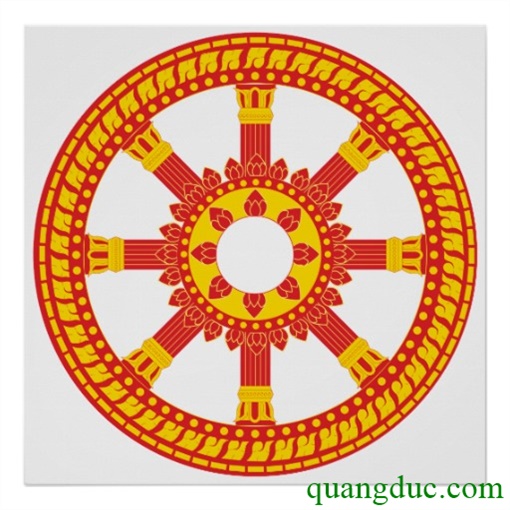
THE WHEEL OF THE LAW
Venerable Sumangalo
Usually, we call The Wheel of the Law by its Sanskrit name of Dharmacakra (pronounced Dharmachakra). This is only one of the many sings or symbols which are holy to Buddhists, because they stand for our religion and make us think of its teachings when we see any of these symbols. The lotus is the flower of Buddhism and the tree is the Bo or Bodhi tree. In Burma and northern Siam, the tail of the peacock is often used to represent the glory and beauty of the Dharma. The swastika is another sign much used by Buddhists. Sometimes we see three baskets used to represent the Buddhist teaching. Each of the three baskets stands for one of the three main divisions of the Buddhist holy scriptures. At other times we see a shining jewel used to represent our religion and, frequently, three jewels are used. The one jewel means Truth is like a beautiful gem. The Three Jewels stand for the Buddha, the Dharma and the Sangha.
So many symbols have been used by Buddhists to represent our religion that, finally, a sort of general agreement was reached that Buddhists of all the world would unite to accept the Dharmacakra as being the main sign or symbol of the Buddhist religion. The reason for choosing the wheel is that when Lord Buddha preached His first sermon in the Deer Park at Benares He is said to have “set the wheel of the law in motion.” We all know that a wheel is not of much use unless it is in motion. In fact when we think of a wheel we naturally think of motion. It is the same with our lives. We can go forward, make progress, or else we go backward. All life is motion, and there is no such thing as just standing still or marking time. If we follow the Wheel of Lord Buddha’s Law, then we are in motion towards happiness. The wheel is usually shown with eight spokes.
The Buddha described the wheel in this way: “The spokes of the wheel are the rules of pure conduct (the Eightfold Path), the equal length of all the spokes represent justice; wisdom is the tyre, the hub is thoughtfulness and the axle is the immovable truth.” Just as the cross is the generally accepted sign of Christians, the crescent of Muslims and the Star of David of the Jewish religion, even so, the Wheel of The Law is the one sign of our religion that is recognized all over the world, and we ought to use it more and more, until everyone knows the meaning of this holy symbol. If anyone wishes to wear a badge of the Buddhist religion in the form of a ring or pin or necklace, then the proper symbol to use is the Wheel of The Law. Anyone who wears such a symbol will be constantly reminded that the only true happiness comes from following the Law taught us by Lord Buddha.
THE DHARMACAKRA
When we see the Dharma-Wheel,
Shining with each turn,
We are thus reminded
Of our Lord’s concern;
Concern for every mortal,
That each might find release
From the round of sorrow,
Into perfect peace.
-S. R.
QUESTIONS
- What is another name for the Wheel of The Law?
- How many spokes are there in this wheel?
- What do these spokes mean?
- What is meant by the equal length of all the spokes?
- What does the tyre mean?
- What does the hub mean?
- What flower is a symbol of Buddhism?
- What is the name of the tree of Buddhism?
- Can you name some symbols used by other religions?
- Can we really stand still in life, or must we either go forward or backward?



%7Cutmcsr%3D(direct)%7Cutmcmd%3D(none)%3B%2B__utmv%3D421119049.-%3B)