- 1. Preface
- 2. Notes to Parents and Teachers
- 3. How to Impart Buddhism to Children
- 4. Devotional Exercises
- 5. The Life Story of Lord Buddha
- 6. The One Main Teaching
- 7. The Refuges
- 8. The Five Precepts
- 9. The Four Noble Truths
- 10. Right Understanding
- 11. Right Aims
- 12. Right Speech
- 13. Right Action
- 14. Right Livelihood
- 15. Right Effort
- 16. Right Mindfulness
- 17. Right Meditation
- 18. The Law of Karma
- 19. Rebirth
- 20. The Three Signs
- 21. The Seven Jewels
- 22. The Three Evils
- 23. Our Duties Towards Others
- 24. The Meaning of Wesak
- 25. Trusting to Luck
- 26. The Wheel of the Law
- 27. The Teaching of all Buddha
- 28. The Greatest Secret in the World
- 29. Filial Piety
- 30.Sincerity
- 31. Perseverance
- 32. The Drawings in this Book
- 33. Remembering Lord Buddha
- 34. A Buddhism Catechism
4. DEVOTIONAL EXERCISES
The proper way to start any session of a Buddhist Dharma-school is by use of well-directed devotional exercises. The children should be taught the idea of reverence and the value of making personal devotions a regular part of every individual’s life, beginning in childhood. It is quite a good idea to introduce new formulas of aspiration, subjects of meditation, new songs and poems from time to time, but it is advisable to continue any practice until the children have committed that particular devotion to memory. As a rule, we carry with us all through life, the poems and devotions we learn as boys and girls. The importance of these devotional exercises to go along with each session of a Dharma-school cannot be over-estimated. Some classes have devotions only at the opening of the session each Sunday. In other cases there are both opening and closing devotions. The sample given here is rather a standard one, being widely used in many parts of the Buddhist world.
When all the children are assembled, it is a good idea to let them work some of the noise out of their systems by singing an opening hymn. This is followed by the leader of the school saying:
“GLORY TO HIM, THE BLESSED LORD, THE ALL-ENLIGHTENED ONE, THE PERFECTLY ENLIGHTENED BUDDHA!” (This formula of veneration may be said in Pali, Sanskrit, Chinese or any other language considered suitable in a given school). The children repeat the formula after the leader. It may be three times repeated, if desired. Then it is proper to recite the Three Refuges, with the children repeating them after the chief, teacher or leader.
I TAKE MY REGUE IN THE BUDDHA
I TAKE MY REFUGE IN THE BUDDHA
I TAKE MY REFUGE IN THE BUDDHA
After the Three Refuges, it is a good plan to have the children recite after the Leader:
“Receive us, O Lord Buddha, as Thy disciples. We vow to learn Thy teachings. We vow to follow those holy teachings and to observe the precepts. We vow to be faithful all our lives to the sacred teachings we are now learning. May all beings be well! May all beings be happy!”
This exercise is usually followed by the Five Precepts, given here in language that is not beyond the comprehension of the very young. Needful to say, this formula is not a literal translation from the original language.
I PROMISE NOT TO KILL.
I PROMISE NOT TO STEAL.
I PROMISE NOT TO BE IMPURE.
I PROMISE NOT TO BE UNTRUTHFUL.
I PROMISE NOT TO USE ALCOHOL OR EVIL DRUGS.
There is another version of the precepts known as “The Expanded Five Precepts.” Some Dharma-schools use this second version alternately with the simpler version. It has come down to us from an ancient Sanskrit text through a Chinese translation. Here it is:
- I PROMISE TO RESPECT ALL LIFE AND NOT TO HURT ANYTHING
- I PROMISE NOT TO TAKE WHAT IS NOT MINE AND ALSO TO HELP EVERYONE TO BE MASTER OF THE FRUITS OF HIS OWN LABOURS
- I PROMISE NOT ONLY TO AVOID IMPURITY BUT ALSO TO SEEK TO DO ACTUAL GOOD
- I PROMISE TO AVOID ALL UNTRUTH AND DAILY TO SPEAK THE TRUTHIN A HELPFUL WAY
- I PROMISE TO USE NO DRINK OR DRUG THAT WILL POISON MY BODY OR MY MIND AND I SHALL HELP OTHERS TO OVERCOME BAD HABITS
Experience has shown that children like to sing, and it is well to insert a hymn or other song at regular intervals in devotion periods. Usually not less than three songs are used in a devotional period and, if desired, a full half-hour period may occasionally be set apart for singing. If there is no closing devotional period, then the opening period may be brought to a close by reciting:
THE GOLDEN CHAINI OF LOVE
“I am a link in Lord Buddha’s golden chain of love that stretches around the world. I must keep my link bright and strong. I must think only good thoughts. I must speak only good words. I must do only good deeds. May all people everywhere become link sin Lord Buddha’s golden chain of love.”
If there is a closing devotion for the end of the session, then this Golden Chain recitation may be reserved for that time and it is usual to precede and follow it with a hymn.
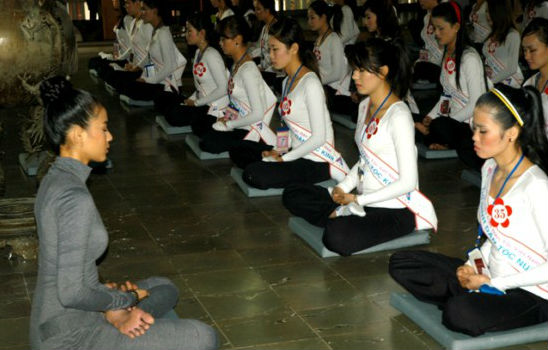
Once or twice a month it is a good plan to encourage the children to practise the meditation postures in either the single or double lotus positions. The following formula, known as “the Radiation of Goodwill’ is then silently “broadcast” by the boys and girls.
“We surround all men and all forms of life with infinite love and compassion. Particularly do we send forth loving thoughts to those in suffering and sorrow, to all those in doubt and ignorance, to all who are striving to find Truth, and to those whose feet are standing close to the gate men call death, we send forth oceans of compassion, love and mercy.”
Many Dharma schools have a little ceremony at each session, for the offering of flowers and joss sticks. The children seem to enjoy this activity, and one of the various verses that can be taught the pupils to use as they make their offerings is:
“Homage to the Lord most holy,
Light of Truth’s Eternal Sun,
Honour, love and adoration
Unto Him, The Perfect One.”
A good plan is to let the girls offer the flowers and the boys the joss sticks on one Sunday and, the following Sunday, to reverse the procedure. Another quotation that can be used as an alternative to the one above given is:
“Lord Buddha, we offer these flowers at Thy shrine that their perishable beauty may remind us of the unfading beauty of Thy Dharma. May the sweet scent of these joss sticks remind us of the nobility of holy living. May all beings be well; may all be happy.”
As a rule, several Sundays, usually not less than two, are required to get the children well practised in the hymns and recitations. It is for this reason that these devotional exercises are listed as Lessons One and Two. Care should be taken that the Dharma school does not lapse into a mere gathering for devotional acts. Devotion has its very real values, but the primary reason for this existence of a Dharma school is to give instruction in the basic teachings of our religion. If we lost sight of that aim, then we no longer have a genuine Dharma school. Let us give everything its proper place and proper value, carefully avoiding all extremes. This course of action will keep us on The Noble Middle Path.
As a responsive reading or recitation, The Seven Jewels of the Dharma is much favoured in Dharma-schools. Usually the teacher reads the first line and the children reply with the second line, and so on. To avoid monotony, it is a good plan to alternate the various devotions given herein. In this way the children learn a wide range of holy thoughts to store away in their young minds and keep with them all through life.
THE SEVEN JEWELS OF THE DHARMA
Leader: Blessed are they that reject evil
Children: For they shall attain purity.
Leader: Blessed are they that aspire to holiness.
Children: For they shall attain serenity.
Leader: Blessed are they that pursue knowledge.
Children: For they shall attain understanding.
Leader: Blessed are they that promote peace.
Children: For they shall attain true happiness.
Leader: Blessed are they that seek truth.
Children: For they shall attain wisdom.
Leader: Blessed are they that practise virtue.
Children: For they shall attain perfection.
Leader: Blessed are they that follow the Path.
Children: For they shall attain enlightenment.
One of the most beautiful invocations ever to come from any language or country is from ancient Siam and is known as:
THE INVOCATION OF THE ETERNAL
O Thou Eternal One,
O Thou Perfection of Time,
Thou Truest Truth.
Thou Immutable Essence of All Change.
Thou most Exalted Radiance,
Thou Radiance of Mercy.
Thou Infinite, Thou Infinite Compassion,
Thou Pity, Thou Pity.
Thou Charity, Thou Infinite Charity,
O Thou Eternal One, O Thou Eternal One.
Whenever a devotion contains words of a nature not likely to be easily understood by children, such terms should be carefully explained to the class. In this way it is unnecessary to alter the beauty of the original utterance. Moreover, when the children have reached adulthood they will remember the devotion in all its beauty and will profit all through life by keeping its deep truth in mind.


%7Cutmcsr%3D(direct)%7Cutmcmd%3D(none)%3B%2B__utmv%3D257603302.-%3B)