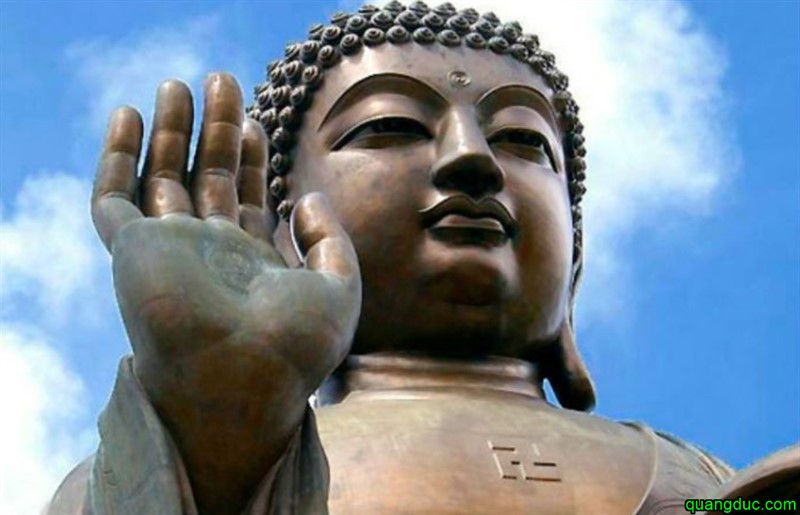
"Now " by Ven. Shih Jingang

03/05/202117:33(Xem: 14502)
"Now " by Ven. Shih Jingang

duc the ton-10


“NOW”

By Ven. Shih Jingang


No past, no present, no future.  All created things arise and pass away.  All names and labels dissolve.  You can observe this in meditation practice and, in experiencing impermanence in life and so-called death.


At the conclusion of the Diamond Sutra, it is said that, this is how we should view our conditioned existence: as a star at dawn, a bubble in a stream, a drop of dew, a flash of lightning in a summer cloud, a flickering lamp, a phantom and a dream.


I had the privilege of knowing a woman who had so completely immersed herself in the Buddha’s teachings, that, by the time of her passing from this life she embodied the Dharma. What follows is a prayer of dedication to her, the Three Jewels and to all sentient beings:


Now is the time of awakening to this precious moment.

“I take refuge in the Awakened One.”


Now is the time of realising, that,

I am the Light itself, the Dharma is the light.

“I take refuge in the Dharma of the Awakened One.”


Now is the time of Compassion for all suffering beings.

“I take refuge in the Sangha of the Awakened One.”


May all beings experience the unconditional embrace of

Boundless Compassion.

May the radiant light which emanates from its heart

lead all to blissful freedom.

May all sentient beings be liberated from suffering.


Namo Amitabha!
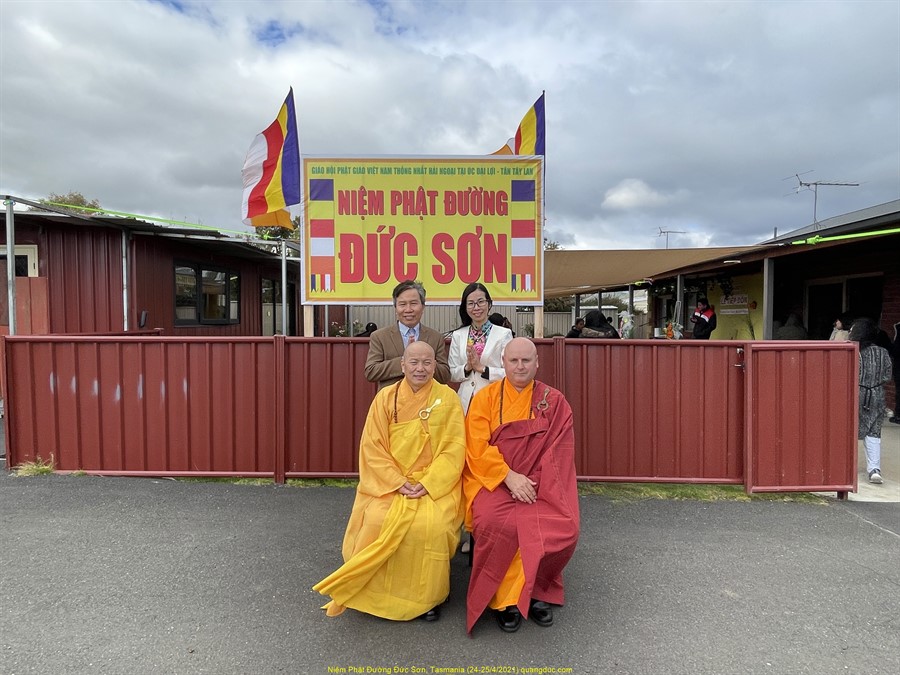


niem phat duong duc son (43)Ven Nguyen Tang & Ven Shil Jingang at Duc Son Buddhist Center, Bothwell, Tasmania (24/5/2021)


***
youtube


Gửi ý kiến của bạn
Tắt
Telex
VNI
Tên của bạn
Email của bạn
13/09/2011(Xem: 5859)
Clearly the Mindfulness is a shadow (image, light, sound, stimuli, etc…) that our senses are perceived fully from its form of emptiness. With the perfect sense, it is without space-time.
29/08/2011(Xem: 9578)
The Prajna-paramita-sutra describes "prajna" as supreme, highest, incomparable, unequalled, unsurpassed thought. Prajna is wisdom, knowing or understanding.
22/05/2011(Xem: 5362)
Buddhism is a religion of the truth. Buddha is a great healer. The three Collections of the Buddhist Canon consists of 84,000 wonderful Dharma Paths, which are 84,000 miraculous medications to be used to cure 84,000 kinds of “illness caused by delusions” of sentient beings. It therefore, brings about harmony and happiness to those who BELIEVE IN and who APPLY that endless source of awakened and liberated Dharma lights during the course of their ordinary lives.
18/05/2011(Xem: 14643)
The perception of the human mind to the existence of an after-world with an equally puzzling after-life has led to the creation of a space equally occupying time, where the spirit is rewarded or punished for its earthly actions. This co-consequential existence, both terrifying and awesome, has been used as a tool by religions from time immemorial in order to coerce a person to maintain a dignified and pure existence. Dante’s heaven and hell depicting both the fiery abyss and the perception of purity is not that much different from similar concepts put forward by other religious groups.
17/05/2011(Xem: 6172)
One of the frustrating quandaries confronting North American Buddhists and those interested in Buddhism here is how to translate Buddhist ideas and ideals and Buddhist actions into our own local idiom, our own modes of understanding, thought, and action. This is not just about finding suitable translations for words like dharma or sunyata.
17/05/2011(Xem: 6427)
Since our idea of the void is due to the environing matter, and since all matter, from the point of view of the elemental analysis, depends on the primary elements, the space-element, too, can be said to depend on them.
17/05/2011(Xem: 5347)
I have been asked to compare and contrast the methods of understanding reality as given by these great thinkers. What do we mean by the methods of understanding reality? It could mean a technique or instrument that can be used to investigate and search. On the other hand it could mean an ability or a principle working within the human mind that enables us to understand reality.
17/05/2011(Xem: 5403)
I have been asked to give a talk on the Two Truths: the conventional or surface level of truth and the ultimate truth. Looking at it one way it seems as if I've already finished my teaching because there are just these two words: conventional and ultimate, and that's finished! But in fact these two truths subsume within them all of Buddhism, so there is more to talk about than you'd find in a huge beak.
15/05/2011(Xem: 10493)
In his initial remarks, His Holiness dwelt on his two commitments of promotion of human values and promotion of religious harmony.
14/05/2011(Xem: 5052)
The fundamentals of the principal practices of Dharma ought not to be changed. For example, the bases of Bodhicitta (the altruistic attitude of` striving for Buddhahood as a means of benefiting all beings) and Sunyata (Emptiness, the ultimate nature of mind and of all things) will always be required by practitioners. However, in order to get at the essence of these practices, their secondary details-such as the sequential order of the ways in which they are approached, the specifics of the visualizations involved in them and so forth-might well be modified to accord with the differing mentalities of given people.
