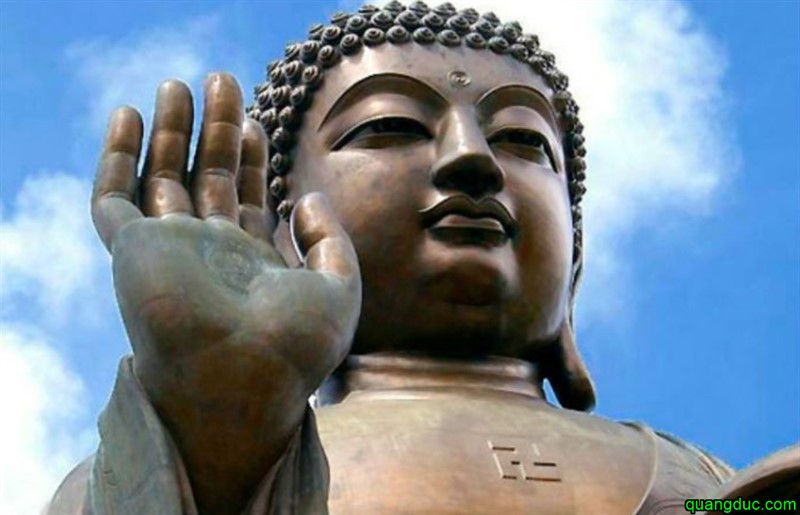
"Now " by Ven. Shih Jingang

03/05/202117:33(Xem: 14700)
"Now " by Ven. Shih Jingang

duc the ton-10


“NOW”

By Ven. Shih Jingang


No past, no present, no future.  All created things arise and pass away.  All names and labels dissolve.  You can observe this in meditation practice and, in experiencing impermanence in life and so-called death.


At the conclusion of the Diamond Sutra, it is said that, this is how we should view our conditioned existence: as a star at dawn, a bubble in a stream, a drop of dew, a flash of lightning in a summer cloud, a flickering lamp, a phantom and a dream.


I had the privilege of knowing a woman who had so completely immersed herself in the Buddha’s teachings, that, by the time of her passing from this life she embodied the Dharma. What follows is a prayer of dedication to her, the Three Jewels and to all sentient beings:


Now is the time of awakening to this precious moment.

“I take refuge in the Awakened One.”


Now is the time of realising, that,

I am the Light itself, the Dharma is the light.

“I take refuge in the Dharma of the Awakened One.”


Now is the time of Compassion for all suffering beings.

“I take refuge in the Sangha of the Awakened One.”


May all beings experience the unconditional embrace of

Boundless Compassion.

May the radiant light which emanates from its heart

lead all to blissful freedom.

May all sentient beings be liberated from suffering.


Namo Amitabha!
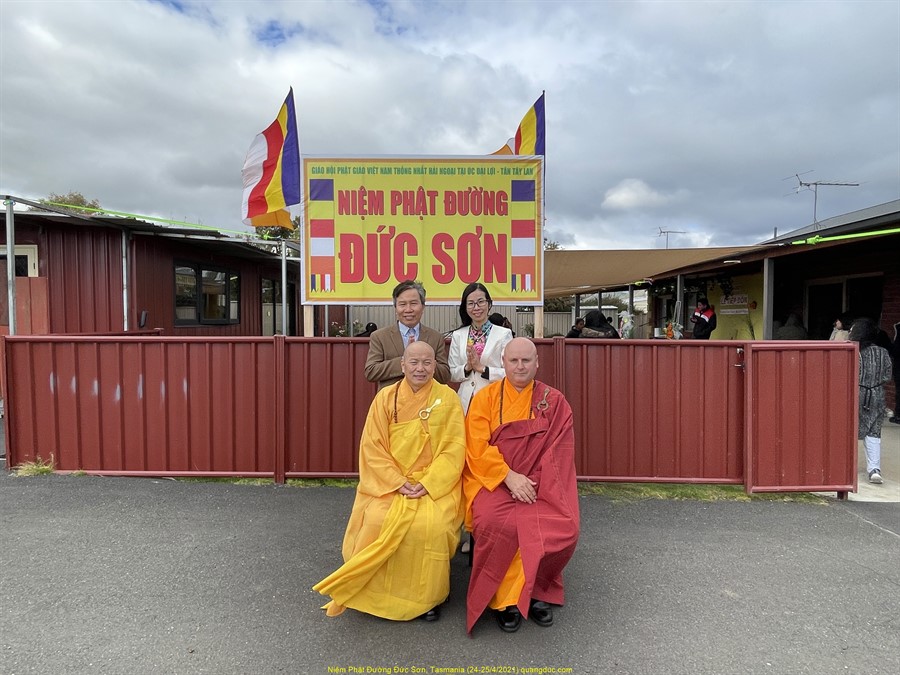


niem phat duong duc son (43)Ven Nguyen Tang & Ven Shil Jingang at Duc Son Buddhist Center, Bothwell, Tasmania (24/5/2021)


***
youtube


Gửi ý kiến của bạn
Tắt
Telex
VNI
Tên của bạn
Email của bạn
14/05/2011(Xem: 5288)
When we talk about Buddhism as the path with a heart, as I've kindly been asked to do, the title itself raises some questions. For example, The path with a heart. Does this imply that other paths don't have a heart? Then there's path. Is Buddhism a path? And finally, heart. What is the heart of Buddhism?
14/05/2011(Xem: 5128)
The Sanskrit word Dharma, chö in Tibetan, means to hold, or to uphold. What is upheld, or maintained? The elimination of suffering and the attainment of happiness. Dharma does this not only for ourselves, but for all beings.
14/05/2011(Xem: 5574)
The purpose of meditation is to gain realizations leading to the cessation of delusion and superstition. This cessation depends, first of all, on recognizing the character or function of the deluded mind.
13/05/2011(Xem: 7303)
Buddhism was an important ingredient in the philosophical melange of the Indian subcontinent for over a millennium. From an inconspicuous beginning a few centuries before Christ, Buddhist scholasticism gained in strength until it reached a peak of influence and originality in the latter half of the first millennium.
13/05/2011(Xem: 6404)
When Buddhism first entered China from India and Central Asia two thousand years ago, Chinese favourably disposed towards it tended to view it as a part or companion school of the native Chinese Huang–Lao Daoist tradition, a form of Daoism rooted in texts and practices attributed to Huangdi (the Yellow Emperor) and Laozi.
13/05/2011(Xem: 6295)
Science is the cornerstone of the European-American culture that has transformed the entire globe over the last few centuries. Buddhism is a deeply rooted religious tradition of Asia, now emerging as a powerful global voice. Science and Buddhism both address the nature of human experience, but in quite different ways.
13/05/2011(Xem: 5092)
We always use the word, "ego." But although we're all the time saying, "ego, ego, ego," we don't realize the ego's psychological aspects, its mental attitude. We interpret the ego as some sort of physical entity. Therefore, it is necessary to discover that the ego is mental, not physical. That's so worthwhile.
13/05/2011(Xem: 5677)
Lama.Thubten.Yeshe.(15.5.1935, 5:00 LMT (6:05 GMT), Töling Dechen/Lhasa/TIB - 3.3.1984, 5:07 PST, Los Angeles/USA), also called "Hippie Lama" was one of the most outstanding personalities of the Seventieth and early Eighties. Beside Chögyam Trungpa he was one of the first Tibetan teachers, who managed to explain Buddhism in a modern and unorthodox way. The result of a careful study of our Western mentality and culture.
12/05/2011(Xem: 5301)
The Buddha taught so that beings would be happy and satisfied. Having attained the ultimate happiness of enlightenment himself, out of love and compassion for each sentient being he wanted to share his experience with them all. But he could not transplant his realizations into the minds of others, remove their suffering by hand or wash away their ignorance with water-he could only teach them to develop their minds for themselves, as he had done. Thus he showed the path to enlightenment.
11/05/2011(Xem: 4832)
The enlightened attitude, the bodhimind that has love and compassion as its basis, is the essential seed producing the attainment of buddhahood. Therefore it is a subject that should be approached with the pure thought, "May I thus gain enlightenment in order to be of greatest benefit to the world."
