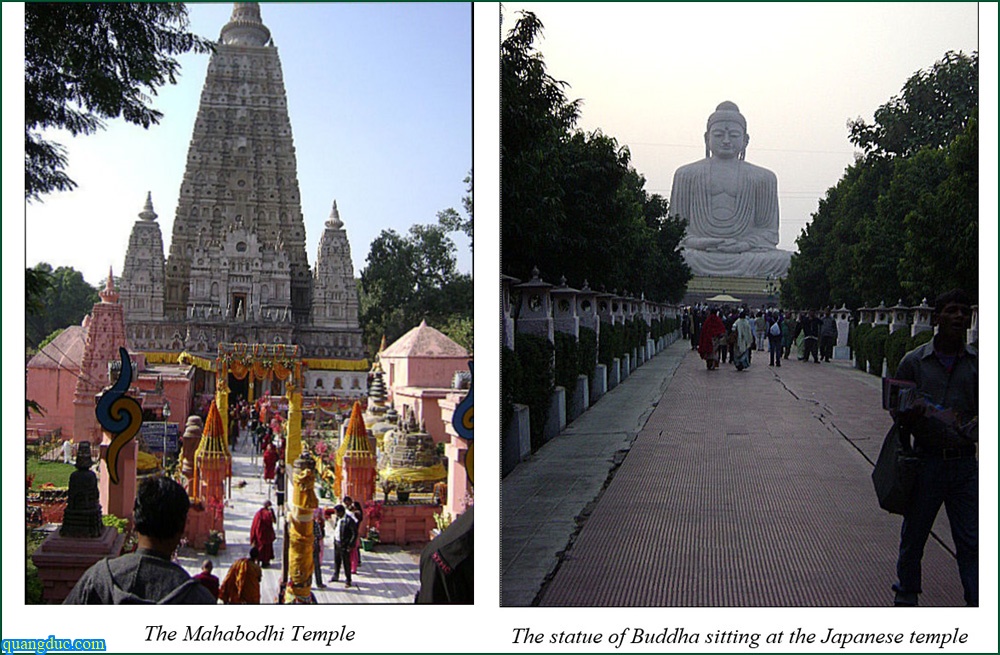
My pilgrimage to India (December 15th, 2010 – January 1st, 2011)

11/01/202317:27(Xem: 2317)
My pilgrimage to India (December 15th, 2010 – January 1st, 2011)

hanh huong 2

My pilgrimage to India


December 15th, 2010  –  January 1st, 2011

Tran Khanh Tuong


In September 2010, I decided to go on a pilgrimage in India with a group of devotees from the Van-Hanh Pagoda in Nantes. It took me two months to get everything I needed: airplane tickets, passport and visas. International law requires that your passport must be valid at least 3 months after leaving the country you are visiting. I was very happy waiting for the day of departure.


But … (Why is there always “BUT”?) two weeks before the departure I suddenly developed health problems, and serious ones to top it off ! Should I cancel the trip? “No, I cannot” I thought. I had promised a friend to undertake this trip with her. A promise is a promise. I also made a commitment to the Abbott of Van-Hanh pagoda. I decided to go on the trip after consulting my doctors. They allowed me to take the voyage, giving me all sorts of advice - really orders.


December 15th, 2010:


The day of departure arrived – a little too soon for me. My friend’s cousin drove us to Bordeaux airport at 3 a.m. From there we took the plane for New Delhi with a stopover in Amsterdam. At Amsterdam airport we joined the other pilgrims. The biggest group was from Nantes, another group came from Denmark, and a lone woman from Germany. Together we flew to New Delhi and arrived at 1 a.m. on the 16th of December, 2010. Here two other groups were waiting for us, one from Australia and the other from Viet-Nam. A Vietnamese nun, Sister Tuê-Dam-Huong who had studied Buddhism in India welcomed us and took us to a hotel in New Delhi to rest. There were four French women from Nantes. One Vietnamese lady among the faithful of Nantes, who knew Buddhist terms, acted as translator for the French ladies.

Sister Tuê-Dam-Huong organized our pilgrimage from A to Z: hotels, restaurants, bus etc. We were 35 in total including Venerable Thich-Thiên-Huê from Viêt-Nam, Venerable Thich-Nguyên-Lôc, Abbot of Van-Hanh Pagoda, Venerable Thich-Nguyên-Hung and Sister Tâm-Nghia from Van-Hanh Pagoda, Sister Tuê-Dam-Huong and the rest of us, mere mortals from all over the world. As the oldest I was given priority, a place in the front rows of the bus to be less shaken, because the roads were “infernally” bumpy according to the young people at the back of the bus.



pdf icon-2
My pilgrimage to India_Tran Khanh Tuong


***

Vietnamese Version


Gửi ý kiến của bạn
Tắt
Telex
VNI
Tên của bạn
Email của bạn
27/07/2017(Xem: 8112)
The Most Venerables, Venerables, Professors, Researchers, Monks, Nuns, Lay Buddhists, and every bodies are present today. I would like to introduce cultural life, living spirituality of ASEAN countries and discussing the role of religion in this area.
21/04/2017(Xem: 4126)
For me, the Japanese language is the third foreign language I have learnt. In 1972, when I first arrived in Japan, I did not know any Japanese words. In 1971, after graduating from high school as an ordained monk, I was interested in going to college in Japan. I went to the Embassy of Japan in Southern Vietnam to inform myself and applied for a study trip. The result was that I arrived in Japan on 22 February 1972. First, I had to find a language school to learn Japanese. The Japanese language school Yottsuya accepted my application and I have learned Japanese for 9 months. Next, I passed the entrance test to enter the Teikyo University in Hachioji. I majored in Education at the Department of Literature.
11/04/2017(Xem: 10076)
Unlike most other NESB or CALD communities, the Vietnamese came to Australia in large numbers within a rather short period of time when the host multicultural society was still in its infancy. Their presence as an Asian visible minority was really a test to the strength of Australia’s political leadership and tolerance of the population at large. Initially without any intra structure of support, Vietnamese Australians learned to adapt themselves to the new social and cultural environment to become a vibrant community with tangible and intangible contributions to Australia. In future growth however, Vietnamese Australians appear to face a challenge as today’s new settlers from Vietnam bear little commonality in life experience and outlook with the essentially Vietnamese refugee community of the past few decades.
27/03/2017(Xem: 52289)
The Seeker's Glossary of Buddhism By Sutra Translation Committee of USA/Canada This is a revised and expanded edition of The Seeker's Glossary of Buddhism. The text is a compendium of excerpts and quotations from some 350 works by monks, nuns, professors, scholars and other laypersons from nine different countries, in their own words or in translation. The editors have merely organized the material, adding a few connecting thoughts of their own for ease in reading.
20/03/2017(Xem: 10942)
We warmly invite you to be part of the Vesak Friendship Dinner at Quang Minh Temple on Saturday 22nd April. Below for you is the Vesak Friendship Dinner flyer. Please print out, display and circulate among your community for everyone to come along... Book Your Tickets and Tables Today The Vesak Friendship Dinner brings our diverse and growing VictorianBuddhist community together for a social evening, vegetarian cuisine and traditional and cultural performances by groups from across Melbourne.
26/10/2016(Xem: 42020)
In India in the 6th century BC, Sakyamuni, "a wise man of the Sakya tribe", had been meditating under a tree when, suddenly, he was struck with the comprehension of all things. He became Buddha, meaning the « Illuminated ». His message, based on a pragmatic philosophy, taught how to free oneself from all needs in order to achieve illumination. After the death of the Enlightened One, his disciples – a few monks – began to spread his teachings all over India, from Ceylon to the Himalayan. Fearing man’s penc
11/04/2015(Xem: 15798)
Born out of a tragedy in Vietnam, the Vietnamese Australians’ presence appears to be different from others within the culturally and linguistically diverse (CALD) communities of Australia, in that, through government refugee intake, their community multiplied by 16 times over its first five years of resettlement since 1975, and 62 times during its first two decades. As more than 50% of the Vietnamese community are Buddhists, this rapid growth posed a great challenge to a handful of Vietnamese Buddhist monks and nuns who pioneered their Dharma journey in the early 1980’s by building temples and providing religious teaching and service for believers around Australia. They had to overcome secular obstacles as well as organisational and demographic changes. In the process, they have made notable contributions to Australia’s tangible and intangible cultural heritage.
07/04/2015(Xem: 4635)
Almost five years ago on June 1st 2010, I arrived with my two dogs in Tasmania to start a Ph D in Buddhist philosophy at the University of Tasmania and to continue my training in Clinical Pastoral Education, a form of professional preparation for chaplains and Pastoral/Contemplative Care Workers. On our way south to Hobart my attention was drawn to my right, looking towards the north west of this island state. I felt that I had an appointment with somewhere in that direction and that it would be important for my life.
01/04/2015(Xem: 12536)
Vesak festival at Melbourne city, 23-4-2015
22/11/2014(Xem: 4559)
The World Fellowship of Buddhists Review Vol 3 No 2 Sep-Dec 2557 (2014) - 1. Belong to WFB, and abide by constitution reflecting a non-profit, non-sectarian, nonpolitical international organisation. 2. Endeavours at all times to do its best to the extent possible, while meeting every situation with equanimity. No effort is made to solicit or acquire financial benefit or undue gain. 3. Does not necessarily endorse the views expressed by published contributors and reserves the right to review edit any contribution prior to publication. 4. Reserves the right to reject any contributions which might damage to, or misunderstanding about Buddhism, also to individuals, groups,
