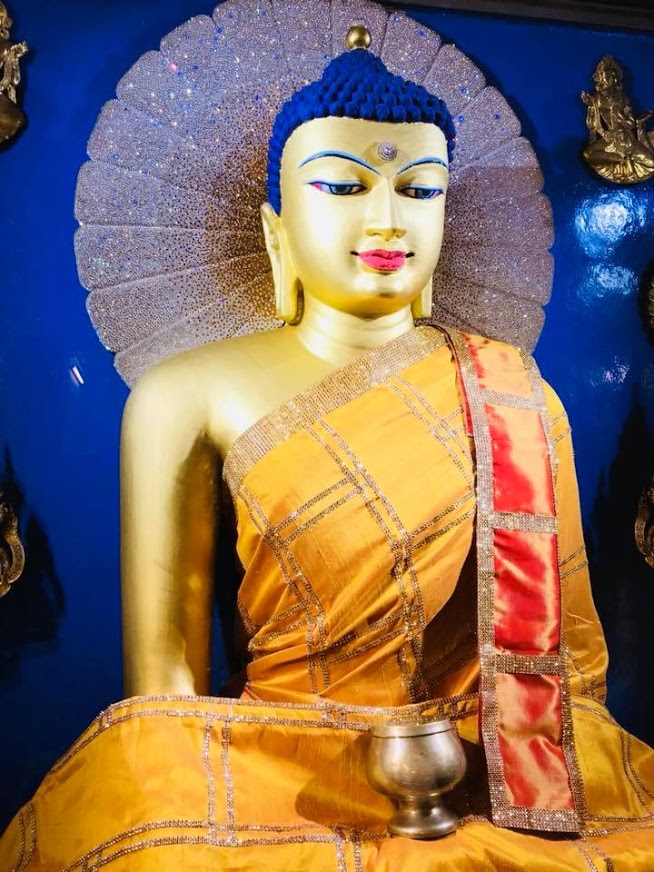
‘Dukkha and The Cessation of Dukkha’ are the heart of the Buddha’s teaching which are expounded in the Dhammacakka-ppavattana-suttaṃ(Setting in Motion the Wheel of Truth).[2]
‘Idaṁ dukkhaṁ ariyasaccaṁ’ pariññeyyan-ti
‘this is the noble truth of suffering’ refers (i.e. suffering itself) ought to be fully known.[3]
This statement is known through the simile of the cloth[4] as follow: suppose a cloth were defiled and stained, and a dyer dipped it in some dye or other, it would look poorly dyed and impure in colour. Because of the impurity of the cloth.
So too, when the mind is defiled, an unhappy destination may be expected. There are 16 imperfections of the mind. They are:
1. Covetousness and Unrighteous greed(abhijjhā-visamalobha),
2.Ill will(vyāpāda),
3.Anger(kodha),
4.Revenge/hostility (upanāha),
5.Contempt(makkha),
6. a domineering attitude(palāsa),
7.Envy(issā),
8.Avarice/ stinginess (macchariya),
9.Deceit(māyā),
10.Fraud(sātheyya),
11.Obstinacy(thambha),
12.Presumption(sārambha),
13.Conceit(māna),
14.Arrogance(atimāna),
15. vanity (mada),
16. negligence(pamāda).
‘Idaṁ dukkhanirodhaṁ ariyasaccaṁ’ sacchikātabban-ti
‘this is the noble truth of the cessation of suffering’ refers (i.e. Nibbāna) ought to be experienced.[5]
The one who has given up, expelled, released, abandoned, and relinquished [the sixteen imperfections of the mind(cittassa upakkilesa)] in part, he gains inspiration in the meaning, gains inspiration in the Dhamma, gains gladness connected with the Dhamma. When he is glad, rapture is born in him; in one who is rapturous, the body becomes tranquil; one whose body is tranquil feels pleasure; in one who feels pleasure, the mind becomes concentrated.[6]Similarly when the mind is undefiled, a happy destination may be expected.
These truths are powers to urge the Buddhain search of the solution such as imperfection, impermanent, emptiness, suffering. It is also the main causeto makeHim enter the world:‘Both formerly and now, monks, I declare only suffering and the cessation of suffering’.[7]
Indeed, lack of reference to involve in the Awakening of the Four Noble Truths, there are people living the household life, enjoying the five pleasures of the senses (i.e. rūpa/ visible , sadda/ audible, gandha/ odour, rasa/ taste, phoṭṭhabba/ tangible), they are referring to and attending to evil, unskillful thoughts which are imbued with desire, aversion and delusion: ‘He is a person, a subject to birth, aging... illness... death... sorrow... defilement, he seeks (happiness in) what is likewise subject to illness... death... sorrow... defilement’.[8] It is ignoble search.
While the second ones are involved in the searching for the unborn, aging-less, illness-less, deathless, sorrow-less, undefiled are called noble search.[9]
The Buddha teaches the Buddhist in the meantime should develop the Four Sublime States (Brahma-vihāra) towards all sentient beings with the realization that, during the immeasurable long passage through the saṃsāra, there is being who has ever been one’s mother, father, sister, brother, son, daughter, relative or friend...
These four attitudes are said to be Brahma (sublime) because they are the right or ideal way of conduct towards living beings (sattesu sammā paṭipatti). They are called vihāra (abodes) because these abidings are the best in being the right attitude towards beings.
Here ‘Mettā (loving-kindness, love, goodwill) is the escape from ill-will, it is also the wish for the welfare and happiness of others.
Karuṇā (compassion) the empathy with them in their suffering, it is the escape from cruelty.
Muditā (sympathetic joy), rejoicing in their virtues and success, it is the escape from aversion (boredom) .
Upekkhā (equanimity/ balance of mind), the attitude of detached impartiality towards beings (not apathy/ indifference), it is the escape from greed.’[10]
Among the Four Sublime States (Brahma-vihāra), equanimity is the crown and culmination, because the thoughts of ‘mine, self, I-making’ are forsaken. Thus, the teaching of anattā (emptiness) will be our guide on the path to deliverance and to perfect equanimity of understanding. The unshakeable nature of anattā is the manifestation of the highest strength.
‘Bhikkhus, if a bhikkhu of such virtue, such concentrationand such wisdom uses four kinds of nutriment (āhāra),even that will be no obstacle for him’.[11] Thesefour kinds of nutriment are:
- kabaliṅkāhāra / physical food as nutriment, gross or subtle
- phassa /contact
- mano – sañcetanā / mental volition
- viññāṇa / consciousness
Constituted a human being is non-self (anattā), that constitution is always changed (anicca), whatever is anicca is dukkha ‘Yaṃ aniccaṃ taṃ dukkhaṃ’.[12] Again, a being if it has within itself the nature of arising it has also within itself the nature of cessation. This is meant and often found in original texts of Pāli in the well-known formula:
‘Yaṁ kiñci samudayadhammaṁ,
Whatever has the nature of arising,
sabbaṃ taṃ nirodhadhammaṃ-ti.
all that has the nature of ceasing’[13]
The five aggregates should be known as objects of clinging should be seen as an enemy with drawn sword (S. IV., 174) in the snake simile, as a burden (S. III., 25) according to the Burden sutta, as a devourer (S. III., 87f) according to the To-be-devoured Discourse, and as impermanent, painful, non-self, formed, and murderous, according to the Yamaka Sutta (S. III., 112f). In detail, matter should be regarded as a lump of forth because it will not stand squeezing, feeling as a bubble on water because it can only be enjoyed for an instant, perception as a mirage because it causes illusion, formations as a plantain trunk because it has no core, and consciousness as a conjuring trick because it deceives (S. III., 140-2)
Knowing and seeing each of them in regard to this body, the attachment to the five aggregates should be abandoned with proper wisdom,
‘This is not mine (n’etaṃ mama),
This I am not (n’eso’haṃ asmi), and
This is not my self (na me so attā)’.[14]
When one knows and sees thus there is no underlying tendency to conceit ‘I-making or mine-making’. Through dispassion, his mind is liberated. When it is liberated there comes to the knowledge ‘It is liberated’. He understands ‘Birth is destroyed, the holy life has been lived, what had to be done has been done, there is no more coming to any state of being’.[15]
Herein we notice that the Buddha does not say that the five aggregates are unhappy, impermanent, he just simply asks: ‘is it proper to assume that the five aggregates are ‘me, my self, what I am’?[16], if for sure, to put a stop to it. In fact, dukkha or suffering is saṃsāra, the cessation of suffering is tranquillity, Nibbbāna. Both are only aspects of the same reality:
‘When this is, that is. This having arisen, that arises.[17]
(Imasmiṃ sati, idaṃ hoti. Imassuppādā, idaṃ uppajjati).
In the same way, we need to purify bodily acts, verbal acts, and mental acts with repeated reflection to train ourselves. While the observation of the object in terms of its qualities and characteristics brings into being the insight knowledges:
‘When this is not, that is not. This having ceased, that also ceases’ (Imasmiṃ asati, idaṃ na hoti. Imassa nirodhā, idaṃ nirujjhati).[18]
The ariya, a noble one, true man who has been developed aMiddle Way for the abandoning of greed and hate, giving‘vision arose, knowledge arose, wisdom arose, understanding arose, light arose’ in him (cakkhuṁ udapādi, ñāṇaṁ udapādi, paññā udapādi, vijjā udapādi, āloko udapādi).
Therefore, it is easy to recognize that ‘there is no fear, no danger, no disaster for the wise’[19] because the wise are the ones who are in deep belief and freed from birth, aging, death, sorrow, lamentation, pain, distress, despair. They are disciples of the Teacher who lives secluded train in seclusion; they abandon what the Teacher tells them to abandon; they are not luxurious and careless, they are keen to avoid backsliding, and are leaders in seclusion.
They know how to cultivate their unmovable faith and transform it into wisdom to destroy all fetters. It is the reason why the Buddha has ever said that ‘the destruction of the taints is for one who knows and sees, not for one who does not know and see’.[20]
There are seven ways[21] of restrain of all the taints are for a well-taught noble disciple, who has regard for noble ones and is skilled and disciplined in their Dhamma, who has regard for true men and is skilled and disciplined in their Dhamma, understands what things are fit for attention and what things are unfit for attention, reflecting wisely. These taints should be abandoned as follow:
- Taints that should be abandoned by seeing.
- Taints that should be abandoned by restraining.
- Taints that should be abandoned by using.
- Taints that should be abandoned by enduring.
- Taints that should be abandoned by avoiding.
- Taints that should be abandoned by removing.
- Taints that should be abandoned by developing
The Buddha’s attitude towards life is not merely intellectual but practical. It is a realization of what is good and beneficial. It makes an ethical perfection-cum-mental emancipation. This implies a cultivation of good emotions and an abandonment of the bad. Good emotions should always be blended with right understanding, right thought, right speech, right action, right livelihood, right effort, right mindfulness, right concentration, right knowledge(sammā-ṃāṇa) or the knowledge pertaining to the fruit of arahantship and right deliverance (sammā vimutti), the arahant’s liberation from all defilements.
In the final emancipation, all suffering ceases, and Nibbāna is where lobha, dosa and moha are not. The ideal situation should be realised not after death, but now in this very life. The Nibbāna here and now was stressed. When the knowledge of his emancipation (vimuttasmiṃ vimuttmiti ñāṇaṃ) arises, a monk knows, ‘Rebirth has been destroyed. The higher life has been fulfilled. What had to be done has been accomplished. After this present life there will be no beyond’.[22]
The way of life vibrates with caring and taking care. It guards tradition. Heart, mind and body are given to the creation of happiness for others, here and now. There are five ways of happiness, that is, (i) in confidence based on knowledge and personal experience (saddhā) (ii) in morality (sīla) (iii) in learning (suta) (iv) in the practice of giving up things or generosity (cāga) and (v) in wisdom (paññā).[23] As the Way was taught by Lord Buddha in different ways, according to the capacity of individuals, so the practice should differ according to the abilities and requirements of one’s character. That is all a man needs, for goodness is above all.
In brief, ‘This is the one and only way, monks, for the purification of beings, for the overcoming of sorrow and lamentation, for the destruction of suffering and grief, for walking on the path of truth, for the attainment of Nibbāna’.[24] (Ekāyano ayaṃ, bhikkhave, maggo sattānaṃ visuddhiyā, sokaparidevānaṃ samatikkamāya, dukkhadomanassānaṃ atthaṅgamāya, ñāyassa adhigamāya, nibbānassa sacchikiriyāya).
Everyone should has to work diligently and constantly to maintain continuous awareness of mind and body.The practice of Vipassana, leading not to the jhānas but to purification of mind, sati/ awareness can only be understood to mean awareness of the present moment rather than a memory of the past (or a dream of the future).
[1]Vesak 2014 tại Bái Đính
[2]Mahāvagga
[3]Dhammacakka-ppavattana-suttaṃ
[4] M. I, Vatthūpama sutta
[5]Dhammacakka-ppavattana-suttaṃ
[6] M. I, Vatthūpama sutta
[7] M. I, 140
[8] M. I, 26
[9] Ibid
[10] D. III., 248
[11] M. I, Vatthūpama sutta
[12]M. I, No 13
[13]Dhammacakka-ppavattana-suttaṃ
[14]M. III, No 109
[15] Ibid., No 112
[16] M. I, 22
[17]S.II, p.27 - 8
[18] Ibid
[19] A. III, 1
[20] M. I, 2
[21] Ibid
[22]
[23] A. III., p. 66
[24] M. I, 10
(Vietnamese version)


%7Cutmcsr%3D(direct)%7Cutmcmd%3D(none)%3B%2B__utmv%3D243037604.-%3B)