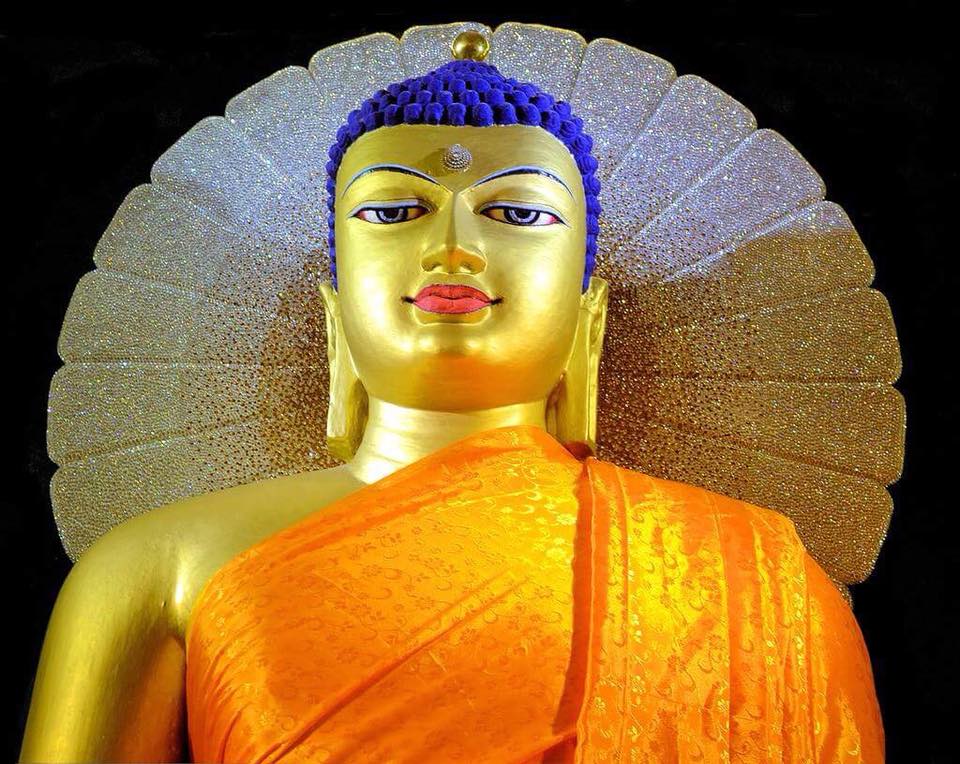
WHAT DID THE LORD BUDDHA TEACH?
(A talk given at London Vihara on 26th May 1986)
Ven. Balangoda Ananda Maitreya
The only person who could answer the question “What did the Lord Buddha teach?” was nobody else but the Buddha himself. Let us see what his answer would be.
One day when the Lord Buddha was staying in the Simsapa forest near Madhura, he picked up a few leaves, and holding them up in his hand, he asked his disciples, “What, bretheren, are more numerous, either the leaves in my hand or those in this vast forest?” They said, “Lord, what you hold in your hand are but few leaves. But a the leaves in this vast forest are uncountably more numerous”.
Then the Lord Buddha rejoined, “In exactly the same way, bretheren, what I teach you ever, now as before, are but very few things out of what I know, and what I teach you are the Dukkha and the cessation of Dukkha.
Why did he want to speak only of these two? It is because only the knowledge of these two things deals with the removal and cessation of all suffering or miseries of one’s life. Here Dukkha or suffering and unsatisfactoriness refer to the unhappy side of life and the cause of its arising and continuity. The cessation of dukkha refers to the attainment of real peace and the way thereto. These four facts are called the Four Great Truths, the description of which is called Buddhism in modern terminology.
The whole purpose of the Lord Buddha was to make his hearers realize these four great facts. He explained these truths in various ways suiting different levels of intelligence of his hearers.
The first of the four facts is suffering and the unsatisfactory nature of the existence which we call world. Wherever we look we see change at every moment with its varied aspects such as birth, decay, pain, sorrow, suffering, diseases, union with the disagreeable, disunion from the agreeable, depression, despair and death. Every living being, from the moment of his birth, goes on uninterruptedly towards death. This life in the world implies a journey towards death. His living or life means his continued or incessant journey towards death. Thus life in the world implies a journey to death, the most disagreeable event, and birth implies the start, the setting out of this predestined journey. Thus, birth in any place where there is death or falling away from the present state is unsatisfactory, in its entirety, let alone its other aspects, decay, disease and the like. The increase in the number of rebirths means the increase of the number of deaths and all other unsatisfactory states.
Why and how does this unsatisfactoriness continue? Beings do not see where they are and what they are. Because of this not seeing, because of this spiritual blindness or ignorance, they are attached to, crave for this unsatisfactory existence, mistaking its deceiving guises for happiness. This craving or attachment is the most powerful force that drags back the beings to be reborn over and over again even when their physical frame falls lifeless. This attachment is the real Satan that is busily working in every worldling.
The truth concerning this attachment is the second one of the four great facts.
If there is disease there is its opposite in health. Heat has its opposite in coolness. Darkness has its opposite in light. In the same way if there is unsatisfactoriness in the forms of decay, disease and so on, there must be its direct opposite state in the form of eternal bliss or everlasting peace, which is the cessation of unsatisfactory existence. The truth concerning this fact is the third one among the four great truths.
The attachment to this unsatisfactory existence is due to ignorance, the absence of realization of the exact nature of this existence. If the same ignorance is rooted out, then attachment the upshot of ignorance finds no ground to arise in.
Just as darkness is removed by light, ignorance is removed or destroying by wisdom, insight or the realization of what we really are. For this purpose we have each to make a deep search for ourselves.
Nothing can be successfully done by one who has no self control. One must have control over one’s speech and deed. Then one should control one’s mind by keeping it from straying. Next to this, one must start one’s search of oneself. This process of practice begins at verbal and bodily control which is named as Sila or virtue or right conduct in Buddhist terminology. Depending on Sila (verbal and bodily discipline) one has to develop mind control, which is termed Samadhi or one pointedness of mind. Depending on this, one must start the search of oneself, the self-investigation, which is called the Vipassana in Buddhist terminology.
This is the three-factored discipline, which is otherwise called the eight-factored path in another way of classification.
The factors of the path are: Right understanding, Right thought, Right speech, Right action, Right livelihood, Right endeavour, Right mindfulness, and Right concentration. Out of these eight factors Right speech, Right action and Right livelihood form the factor of Sila or good conduct, in other words, moral discipline. Right effort, Right mindfulness and Right concentration – these three together from the factor Samadhi or Concentration. Right understanding and Right thought – these two together form the factor of Panna or Insight. This three factored discipline or eight-factored path is the way that leads to eternal peace by destroying the cause of the unsatisfactory existence. This is the last one of the four great truths.
Thus the exposition of these four great Truths is what we call Buddhism, the teaching of the Lord Buddha.
One may ask why the Buddha was not interested in dealing with the questions about the origin of the universe and the like.
Suppose there is a doctor or a physician in charge of a sick ward. He has to attend every patient in the sick ward. Some patients are so ignorant that they eat and drink things which make their diseases serious or incurable. So the physician has to make them understand their situation. Accordingly, he explains to them the nature of their diseases. He explains to them the nature of their diseases. He explains to them the cause of the rise and continuity of their diseases. He explains to them that they can be cured and makes them hopeful and encourages them to take his treatment. Then he gives the treatment. Thus, to explain the nature of their diseases, their cause, that they can be cured and the treatment – these four facts are the only things the patients have to deal with. So the physician deals only with these four things and doesn’t listen to their questions about the things astronomical, geographical, geological and the like which have nothing to do with their diseases or their cure.
The Lord Buddha was the physician or healer of our inner disease such as greediness, hatred, jealousy and the like which make us suffer from all sorts of afflictions. The cause of all these mental diseases is our own ignorance as to our present nature. So he, as our healer, regraded it his duty and service to teach us and make us realize only the Four Great Truths, and did not interfere with other problems which have nothing to do with the freedom from our imperfect and unsatisfactory state.


%7Cutmcsr%3D(direct)%7Cutmcmd%3D(none)%3B%2B__utmv%3D394600756.-%3B)