The Buddhist community is extremely upset by the inappropriate and disrespectful use of the image of Buddha

22/05/201818:16(Xem: 60708)
The Buddhist community is extremely upset by the inappropriate and disrespectful use of the image of Buddha

photo_National Gallery of Victoria-1
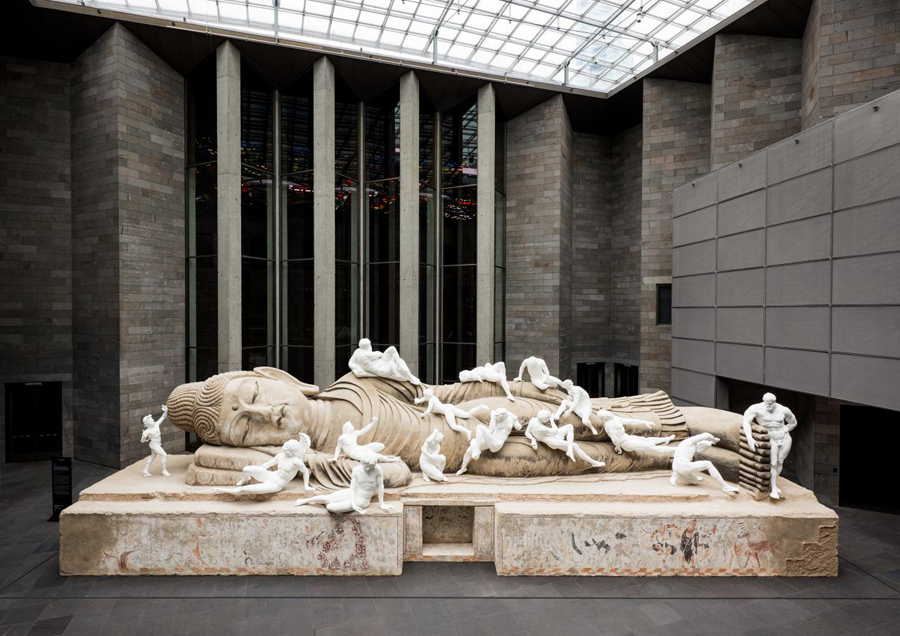
The Buddhist community is extremely upset by the inappropriate and disrespectful use of the image of Buddha, in a display at the National Gallery of Victoria (NGV) entitled the 'Eternity-Buddha in Nirvana, the Dying Gaul, Farnese Hercules, Night, Day, Sartyr and Bacchante, Funerary Genius, Achilles, Persian Soldier Fighting, Dancing Faun, Crouching Aphrodite, Narcisse Couché, Othryades the Spartan Dying, the Fall of Icarus, A River, Milo of Croton'.  It can also be seen at: https://www.ngv.vic.gov.au/explore/collection/work/131149/

Although this display has been in place for some months, we have only just been made aware of its' existence. We are not usually outspoken, but this display desecrates the image of Buddha by placing images of these mythical images on him and in doing so, showing no apparent regard or respect for Him.

It is claimed that the purpose of the work was to bring '...cultural traditions together...', but this is considered, by the Buddhist community, as a totally disrespectful way to achieve this.

The image of Buddha, used in this work, is one of many that can be seen in and around Buddhist Temples and Monasteries around the world. We come to our altars to pray and pay respect to Buddha, to worship and reflect, to meditate and to seek inner peace.

We have suggested that this work would probably not have been commissioned if the central image was Jesus or Mohammed and that public outcry would have been loud and clear, especially for the latter.

We are now aware that others (including the Buddhist Council of Victoria) have written to the Director of NGV. Early responses, to previous letters, have failed to effectively recognise or acknowledge our concerns, nor has any action been taken to resolve this serious problem.

With this petition we offer the Gallery the option to relocate the statues from 'upon' Buddha, to the floor 'around' Buddha. If they do not wish to do this, we must request, in the strongest terms, that the work be totally removed.

How would you feel if an image of someone or something you loved, respected and revered, was used in such a disrespectful way. Please support our petition. Thank you.
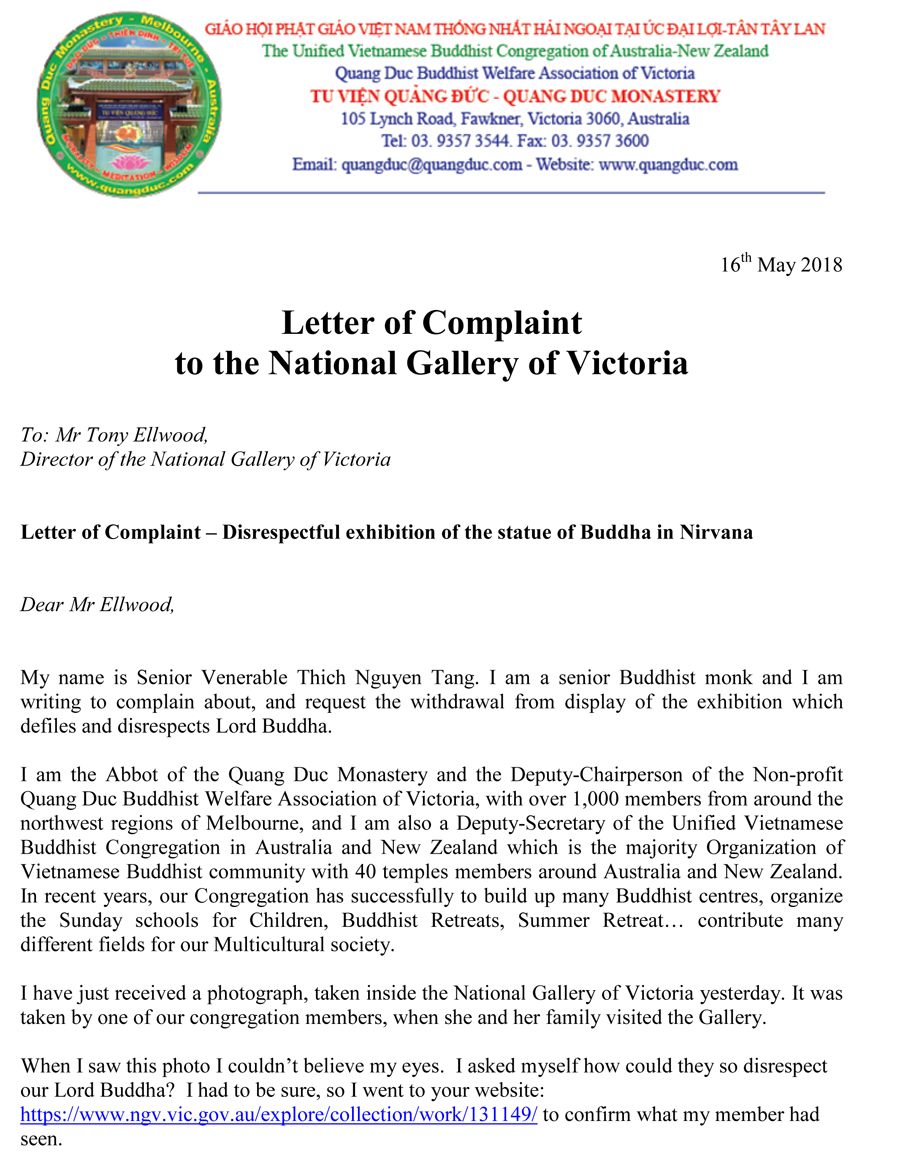
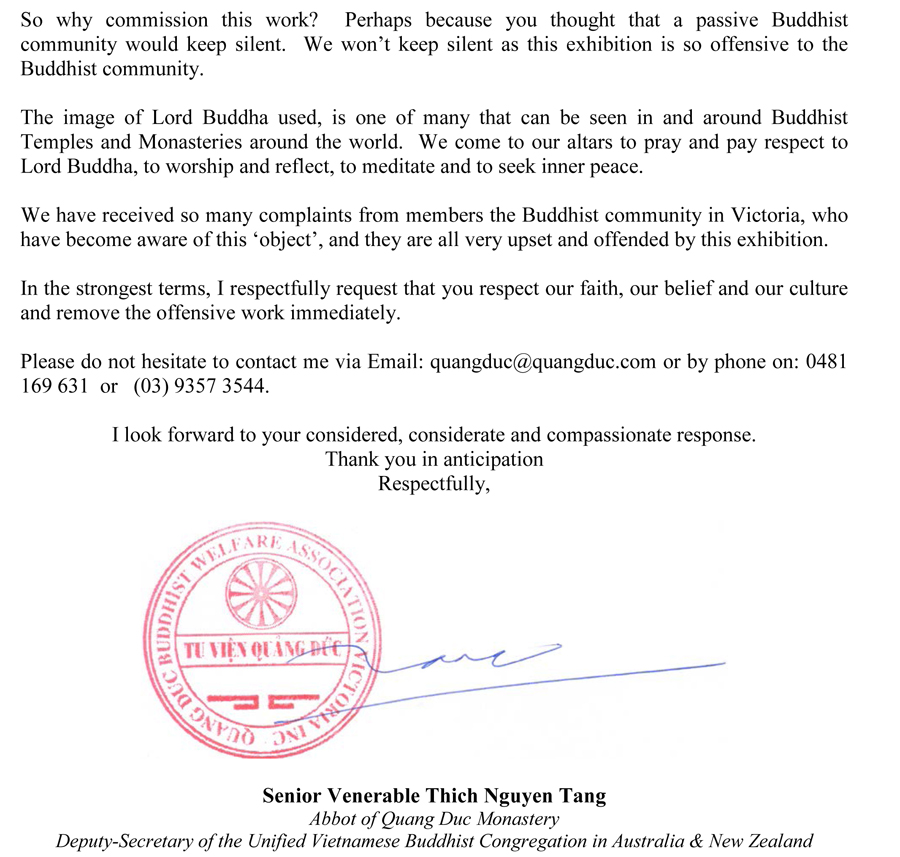
1_Complaint Letter - National Gallery of Victoria_16_5_2018-1

2_Complaint Letter - National Gallery of Victoria_16_5_2018-2

3_Complaint Letter - National Gallery of Victoria_16_5_2018-3

*
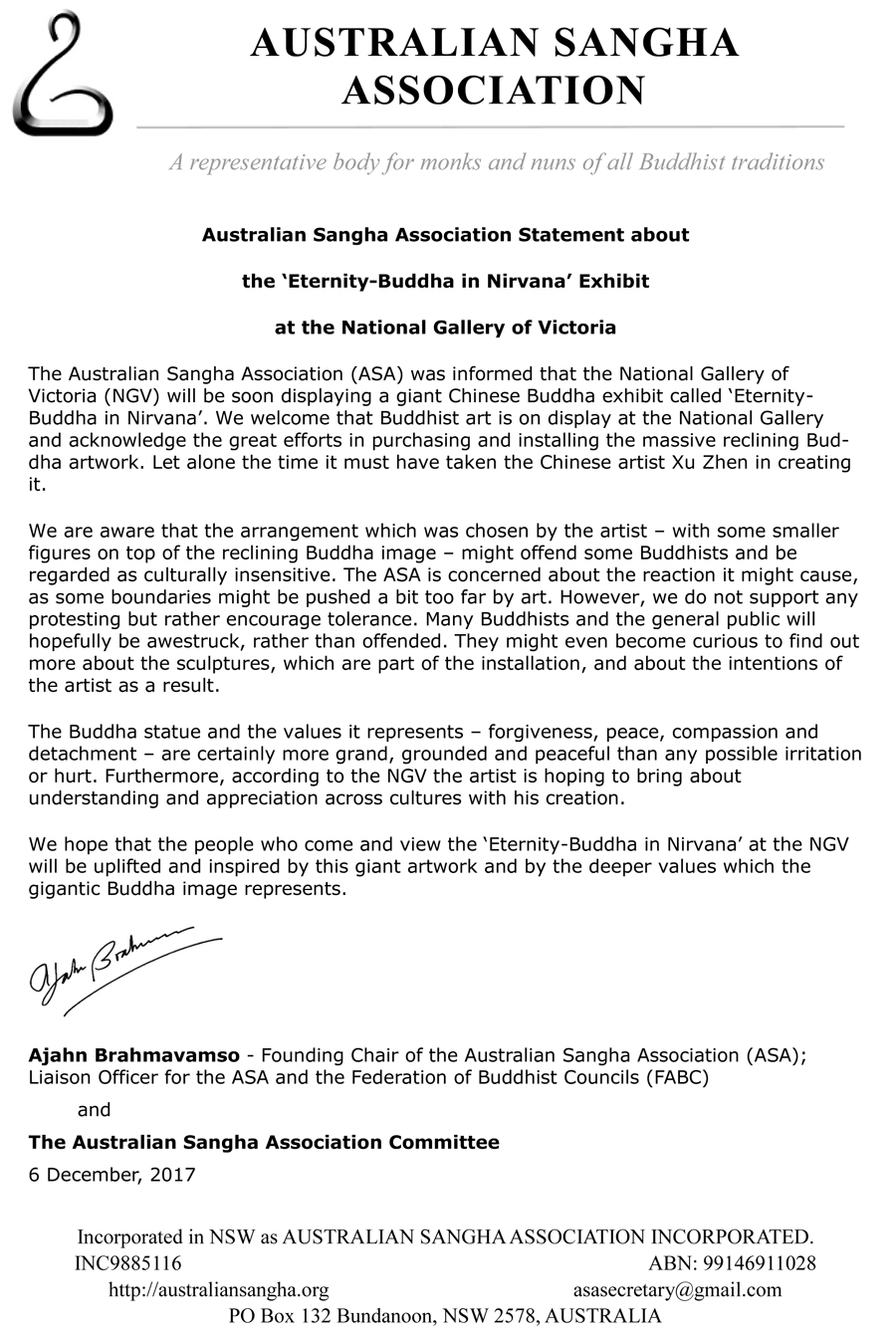
ASA statement re Eternity Buddha at NGV_1
*
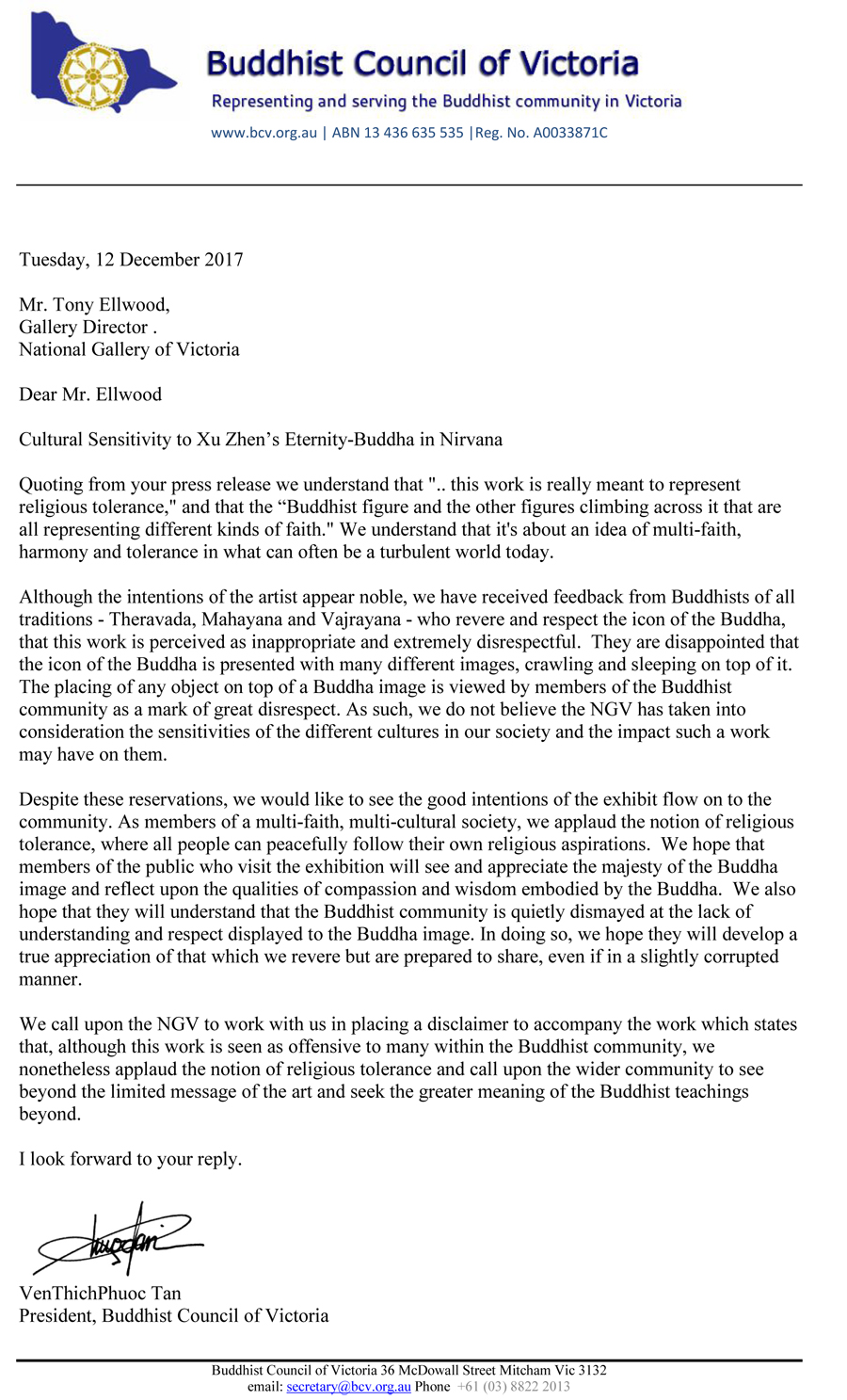
NGV letter final_Thich Phuoc Tan
*
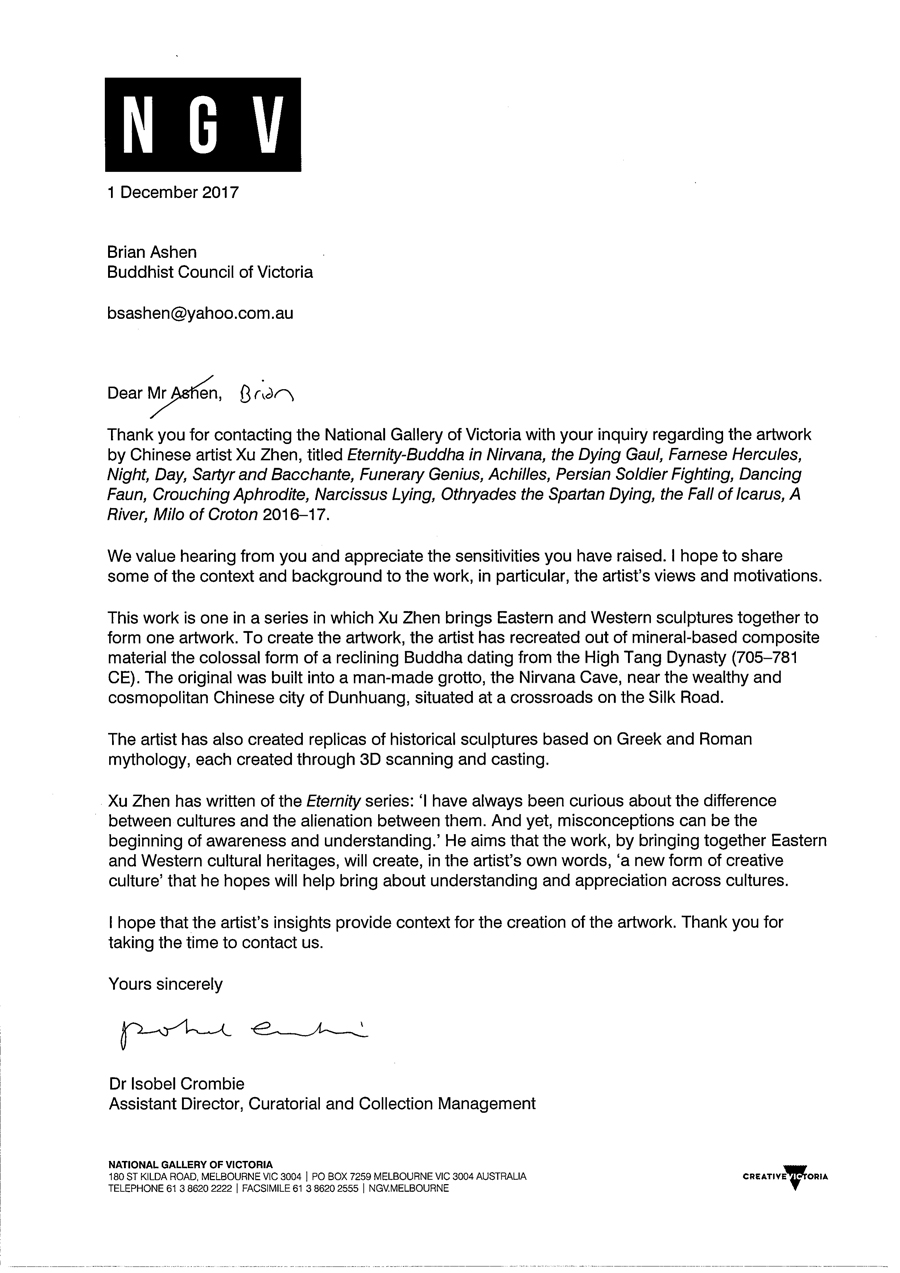
NGV response to Buddhist statue  2017_12_01
*
Letter_NGV_2018


Gửi ý kiến của bạn
Tắt
Telex
VNI
Tên của bạn
Email của bạn
14/05/2015(Xem: 28402)
Amitabha Buddha’s name chanting is an easy method of cultivation in which beliefs are difficult to have, especially in this age of information technology when people care more about material comfort than the spiritual life. However, as in the Buddha’s teachings: Buddhahood is a nature of mind and it’s the mind that possesses the Buddhahood, ringing about enlightenment. Therefore, as Buddhists, we have to believe in Buddha’s teachings. The Flower Adornment Sutra stated: “Beliefs are the mother of all the good merits.”. No other merits are greater than making a vow to be reborn in the Pure Land and to become a Buddha. On the occasion of this year’s retreat, we would like to briefly tell you about an old lady having a belief in Amitabha Buddha’s name chanting
23/03/2014(Xem: 4743)
Is there a literary current of Buddhist inspiration specifically Vietnamese? What are the criteria to differentiate them from the other currents? There has not been unanimity of views on this question among Vietnamese researchers although they agreed that a section of Vietnamese literature, particularly under the Ly and Tran (Xth - XIVth century), has a distinctly Buddhist imprint.
11/03/2014(Xem: 6440)
Buddhism came to Vietnam in the first century CE [1]. By the end of the second century, Vietnam developed a major Buddhist centre in the region, commonly known as the Luy-Lau centre, now in the Bac-Ninh province, north of the present Hanoi city. Luy-Lau was the capital of Giao-Chi, former name of Vietnam, and was a popular place visited by many Indian Buddhist missionary monks on their way to China...
11/03/2014(Xem: 5217)
Huyen Quang was 77 years old when he received from the Venerable Phap Loa the mission of directing the Thien sect (Dhyana, Zen) of Truc Lam, thus assuming the title of Third Patriarch. In view of this age and his love for solitude, one could imagine how reluctant he was when he accepted such a charge. Huyen Quang was eager to return to nature as shown in his following poems.
11/03/2014(Xem: 7575)
Quynh Lam pagoda was a Buddhist center of primordial importance during the Golden Age of Vietnamese Buddhism under the royal dynasties of the Ly (1010-1225) and the Tran (1225-1400). The study of its development will help us to better understand not only the nature of Vietnamese Buddhism but also the phenomenon of acculturation ...
11/07/2012(Xem: 7082)
All many years long, we have travelled the whole states of the USA and provinces of Canada, from west to east, from north to south; we have already visited hundreds of Vietnamese Buddhist temples including big, medium and small ones; with monks or with nuns and even with Buddhist-layman or laywoman; also including temples belonging to Northern Buddhism, Southern Buddhism and Mendicancy sect… Despite in the USA, in Washington D.C or in a remote village in Minnesota, Oregon, New Hampshire, and Louisiana (USA) or in provinces Ontario, Québec or Vancouver city (Canada)…Vietnamese Buddhist Temple is easily recognized from a distance.
08/05/2011(Xem: 19847)
In the long way history of Buddhism, an ancient and profound religion which has been constantly developing and modernising, Buddhist architecture has been changing increasingly both in form and content. From small buts for some monks in early times, they have gradually become large monasteries or Pagodas for a community of monks, together with dome-shaped or multi-faceted stupas enshrining holy Buddhist relics, subordinate structures, stele houses, statues, religious decorations and musical instruments….Today, one can see in a typical pagoda a harmonious and original combination of various characteristic of Buddhist architecture.
06/05/2011(Xem: 4404)
Because now the persecution is worse, Nhat Chi Mai, a Buddhist nun from a good home, with many friends,
05/05/2011(Xem: 4612)
Huyen Quang was 77 years old when he received from the Venerable Phap Loa the mission of directing the Thien sect (Dhyana, Zen) of Truc Lam, thus assuming the title of Third Patriarch. In view of this age and his love for solitude, one could imagine how reluctant he was when he accepted such a charge. Huyen Quang was eager to return to nature as shown in his following poems
05/05/2011(Xem: 5685)
Những ngày trời mưa, sau bữa cơm chiều, có món chè bắp tráng miệng thật là ấm lòng. Bát chè có vị ngọt, thơm của bắp, cùng vị béo của nước cốt dừa.