
Buddha seems to bring tranquility to Oakland neighborhood

08/10/201408:15(Xem: 19527)
Buddha seems to bring tranquility to Oakland neighborhood


Oakland


Oakland_2
   

Dan Stevenson is neither a Buddhist nor a follower of any organized religion.

The 11th Avenue resident in Oakland's Eastlake neighborhood was simply feeling hopeful in 2009 when he went to an Ace hardware store, purchased a 2-foot-high stone Buddha and installed it on a median strip in a residential area at 11th Avenue and 19th Street.

He hoped that just maybe his small gesture would bring tranquillity to a neighborhood marred by crime: dumping, graffiti, drug dealing, prostitution, robberies, aggravated assault and burglaries.

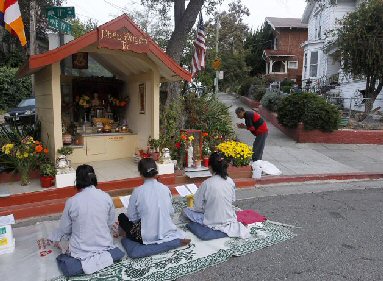
What happened next was nothing short of stunning. Area residents began to leave offerings at the base of the Buddha: flowers, food, candles. A group of Vietnamese women in prayer robes began to gather at the statue to pray.

And the neighborhood changed. People stopped dumping garbage. They stopped vandalizing walls with graffiti. And the drug dealers stopped using that area to deal. The prostitutes went away.

I asked police to check their crime statistics for the block radius around the statue, and here's what they found: Since 2012, when worshipers began showing up for daily prayers, overall year-to-date crime has dropped by 82 percent. Robbery reports went from 14 to three, aggravated assaults from five to zero, burglaries from eight to four, narcotics from three to none, and prostitution from three to none.

"I can't say what to attribute it to, but these are the numbers," a police statistician told me.

Back in 2009, when word got around that Stevenson was the person who'd installed the statue, offerings began to appear on his doorstep. It was like a scene straight out of the Clint Eastwood film "Gran Torino."

"They left a ton of fruit and Vietnamese specialty foods and candy, but there's only me and my wife, Lu, here and we can't eat all that stuff - but it's so good," said Stevenson.

"I've tried to explain to them my reasons" for placing the statue, he said. "I have nothing against it, but I don't believe what you believe!"

I don't think it matters to them.

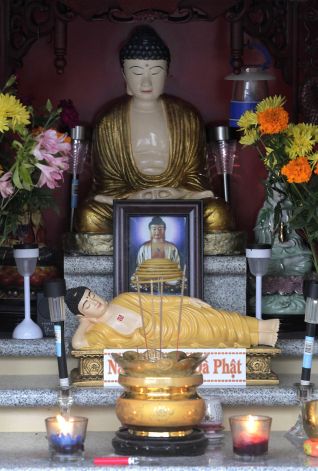
To this day, every morning at 7, worshipers ring a chime, clang a bell and play soft music as they chant morning prayers. The original statue is now part of an elaborate shrine that includes a wooden structure standing 10 feet tall and holding religious statues, portraits, food and fruit offerings surrounded by incense-scented air.

"This used to be a huge spot for dumping stuff," said Alicia Tatum, 27, on an early morning walk with her dogs Lulu and Mya. "But over time, it's blossomed with more and more and more flowers - and they are out there every morning like clockwork."

On weekends, the worshipers include more than a dozen people: black folks, white folks, all folks, said Andy Blackwood, a neighborhood resident. Two weeks ago, a group of German tourists visited the shrine.

"The dope-dealing has stopped, the ladies of the evening have stopped," Blackwood said.

The Buddha has withstood two attempts to remove him from his watch, one criminal and one governmental. Neither has worked.

Soon after its installation, a would-be thief tried to pry the statue from its perch, but Stevenson had secured him with reinforced iron bar and "$35 worth" of a powerful epoxy - and Buddha didn't budge.

In 2012, after a resident's complaint, the city's Public Works Department tried to remove the statue but received such passionate blowback from neighbors that city officials decided to table and "study" the issue. Two years later, the administrative effort is long forgotten, and Buddha is still there.

When I went to visit the shrine, four small-framed ladies who don't speak or understand English decided I looked like a convert.

The moment I started talking, one of them politely took my pen from one hand, my notepad from the other and directed me to clasp my hands together, bow and repeat after her - so I did. When in Rome, right?

Apparently, my Buddhist chants aren't half bad either because they won some approving "oohs and aahs" from the flock - and carried me to Step 2 in the conversion process. The same woman who had grabbed my gear sat me cross-legged on a prayer rug in the street and placed a stool with a book on it before me. If nothing else, Buddha and I share the same body type - short, squat and happy. I sat there for a moment thinking that I might resemble him - and maybe that's why they seemed to like me.

I thought it might be a good opportunity to get a question in, too - and this time my spiritual guide seemed to understand.

"Next week," she replied.

Thank you very much, but I think I've already found what I was looking for.


Chip Johnson is a San Francisco Chronicle columnist. His column runs on Tuesday and Friday. E-mail: chjohnson@sfchronicle.com. Twitter: @chjohnson.

- See more at: http://www.saungon.net/tbl/item_2429.html#sthash.aMzSpCrt.dpuf

Gửi ý kiến của bạn
Tắt
Telex
VNI
Tên của bạn
Email của bạn
03/05/2021(Xem: 11999)
No past, no present, no future. All created things arise and pass away. All names and labels dissolve. You can observe this in meditation practice and, in experiencing impermanence in life and so-called death. At the conclusion of the Diamond Sutra, it is said that, this is how we should view our conditioned existence: as a star at dawn, a bubble in a stream, a drop of dew, a flash of lightning in a summer cloud, a flickering lamp, a phantom and a dream.
03/05/2021(Xem: 10282)
Today I sit alone in a house. The government of the country in which I live has requested that I stay here in isolation for the health and safety of the community both here and abroad. Countless others are doing the same thing, except that some call it a forced lock down, or an obstacle to their free movement. I see this as an opportunity to practice. The Buddha taught that the suffering connected with birth, sickness, old age and death is a fact of life for sentient beings in Samsara. But so is the possibility of transcendence from Samsaric suffering. So, for a practitioner, the question is not just “Why?” but also “How?” Why do I/we suffer and, how do I/we overcome suffering? The answer to the former is found in intuitively recognizing (the 3 Poisons): harmful habits of attachment, anger and ignorance; and the answer to the latter lies in resolving to study and practice the Noble Eightfold Path (the antidote) and, fully realizing Buddhahood for the benefit of a
03/05/2021(Xem: 10445)
In the Dhammapada, the Buddha says, “What we are today comes from our thoughts of yesterday, and our present thoughts build our life of tomorrow: our life is the creation of our mind.” The Covid-19 pandemic has given many millions of people worldwide time to reflect on their lives and habits of thought, speech and action. I know quite a few who have found a refuge of peace in their gardens. Cultivating, planting seeds, adding water and nutrients all help in maintaining a healthy garden. They are also a necessary part in taking care of our bodies. But what about the mind? Generosity, ethics, loving-kindness, compassion, meditative concentration and wisdom are the food for our inner spiritual garden. Without them there is no harvest, no fruit of Awakening, Buddhahood.
03/05/2021(Xem: 9087)
As a child my parents encouraged questions, as did my Heart Lama. However, the latter person gave me two questions to ask before speaking: “will what I am wanting to say, and the way I say it, be helpful or harmful to myself/others? Also, does the question come from ‘I don’t know’ (beginner’s mind), or from a place of judgement and opinions?” The aim was/is to cultivate the mind to be like an empty vessel, not one filled to the brim and overflowing where nothing new can enter.
31/03/2021(Xem: 6892)
Today, once again, I have another opportunityto talk to you through this online Dharma Talk, proposed by Master Hui Siong. He is Vice President of the World Buddhist Sangha Counciland General-Secretary for Chinese Language Department. He is alsoabbot of Beeh Low See Temple, Mahakaruna Buddhist Center and Vihara Mahavira Graha Medan Temple in Singapore and Indonesia. The connections which lead to this opportunity could be traced back through the founding Congress of the WBSC in Colombo, Sri Lanka in 1966 and the second Congress held at Vinh Nghiem Pagoda in Saigon, Vietnam in 1969 by the Most Venerable Thich Tam Chau, co-founder of WBSC. At that time, I had just moved from Hoi An to Saigon; so I did not have theopportunity to participate.
25/02/2021(Xem: 5045)
Today is the first day of the Lunar New Year, on the 12 February 2021 of western calendar. From the faraway Germany, I have had the honor of being invited by the most Venerable Master Hui Siong, abbot of Beel Low See Temple in Singapore and other temples in Malaysia and Indonesia, to have a talk online with you all today. First, I want to thank Master Hui Siong for the invitation, also his secretary miss Jackie and all of you for this opportunity. Buddha has taught us that everything arises with conditions, and the true nature of everything is emptiness. I am sure, as Buddhists, you are familiar with this teaching. He also taught us other teachings, according to Theravada traditions such as: impermanence, suffering and non-self or according to Mahayana traditions: impermanence, suffering, emptiness and non-self. No matter which traditions, these teachings are the common guidelines for us to practice Buddhism. So, when things as sufferings arise, how do we approach and deal with i
12/08/2020(Xem: 10018)
Hungry Ghosts is a suspenseful, character-driven ghost story with heart, humour and scares. Set in contemporary Melbourne during the month of the Hungry Ghost Festival, when the Vietnamese community venerate their dead, four families find themselves haunted by ghosts from the past. As these hauntings intensify, they threaten to unleash their deepest fears and expose secrets long buried. Through an ensemble of characters, both Vietnamese and Anglo, Hungry Ghosts explores the concept of the inherent trauma we pass down from one generation to the next, and how notions of displacement impact human identity - long after the events themselves. Can you ever really leave behind the trauma of your past? Is it possible to abandon both spiritual and physical culture, or does it form part of your fundamental DNA? To free themselves and those they love, each character in Hungry Ghosts must atone for their sins and confront their deepest fears or risk being swallowed by the shadows of their p
08/07/2020(Xem: 17935)
Coronavirus (COVID-19) is not over yet. We need to keep looking after ourselves and our community to stop the virus spreading. Due to increased cases in Victoria, some restrictions have changed. From 22 June 2020: · You cannot have more than five visitors in your home · You cannot gather outdoors with more than 10 people · Schools, libraries, places of worship and businesses remain open · Stay close to home and do not travel if possible
22/06/2020(Xem: 9803)
Balangoda Ananda Maitreya Thero (Sinhala: අග්ග මහා පණ්ඩිත බලංගොඩ ආනන්ද මෛත්‍රෙය මහා නා හිමි;23 August 1896 – 18 July 1998) was a Sri Lankan scholar Buddhist monk and a personality of Theravada Buddhism in the twentieth century.[3][4] He was highly respected by Sri Lankan Buddhists, who believe that he achieved a higher level of spiritual development through meditation.[2][5] Sri Lankan Buddhists also considered Balangoda Ananda Maitreya Thero as a Bodhisattva, who will attain Buddhahood in a future life.
23/05/2020(Xem: 16010)
Dr. Gagan Malik Interview: Mother Nature's Fury with Human Beings | 4 ways to 'overcome' Covid-19, With the rapidly rising number of covid-19 cases in the world's second most populous country, India, and the world's largest lockdown still continuing, I caught up with my friend who is a Bollywood actor, UN Peace Ambassador for South-East Asia and a passionate Buddhist, Dr. Gagan Malik. In this fascinating 47min interview, he shares his various concerns about the covid-19 situation, such as the lack of clear information available on how covid-19 patients are being treated in hospitals, the wastage of time during the lockdown, our mistreatment of Mother Nature/Earth, and also addresses his Buddhists friends on some concerning matters. He also provides some wise suggestions to everyone from a Buddhist point of view on how we can make the most of the lockdown and how collectively as a human race, we can do something about our current dire plight. Thank you so much Dr. Malik for al
