More Than Half a Century of the World Buddhist Sangha Council

09/11/202507:23(Xem: 892)
More Than Half a Century of the World Buddhist Sangha Council
ht nhu dien-dai hoi tan gia-0

More Than Half a Century of
the World Buddhist Sangha Council
Most Venerable Thích Như Điển
 

Since the day the Buddha Shakyamuni attained enlightenment beneath the Bodhi Tree at Gaya, India, more than 2,660 years of history have passed. The radiant light of His compassion and wisdom has inspired countless followers—from Asia to Europe, from Europe to America, Australia, and even to Africa. This enduring influence demonstrates that the Dharma realized by the Buddha under the Bodhi Tree remains universally relevant—adaptable to all peoples, all times, and all places on this Earth.

In the earliest days, the Buddha first guided the five ascetics led by Ajnata Kaundinya to enlightenment, followed by Yasa and forty-nine othermonks at Varanasi, on the banks of the River Ganges, making a total of fifty-five disciples. The Buddha’s first message addressed to the Bhikshus was: “Each of you should travel in a different direction to share and teach the Dharma you have learned!”. This message, simple yet profound, retains its timeless significance even today.


The Sangha, consisting of ordained monastics — both Bhikshus and Bhikshunis — was established first; only afterward came the community of lay followers. The Blessed One also encouraged that the monastics have the duty to propagate the Dharma and benefit all beings, while the lay followers have the duty to support and protect the Three Jewels. These two communities share the responsibility of preserving and fostering the existence and development of the Three Jewels in this world.


After Buddhism took root in India, the teachings of the Buddha were transmitted to other Asian countries by monks and nuns along both the Southern and Northern traditions. As a result, Mahayana and Theravada Buddhism established themselves in these regions. From there, the light of wisdom gradually spread to other continents, sustained by the dedicated practice, study, and conduct of the monastics, as well as the devotion and effort of lay Buddhists.


Monastics live without personal families, preserving the original lineage established during the Buddha’s lifetime, while lay practitioners live within families, maintaining their ancestral traditions and supporting the Three Jewels. Thus, wherever Buddhism spreads, both the monastic and lay dimensions are fully present, ensuring the continuous transmission of the Buddha’s teachings to all people and places, just as he initially conveyed in his Message to the fifty-five Bhikshus.


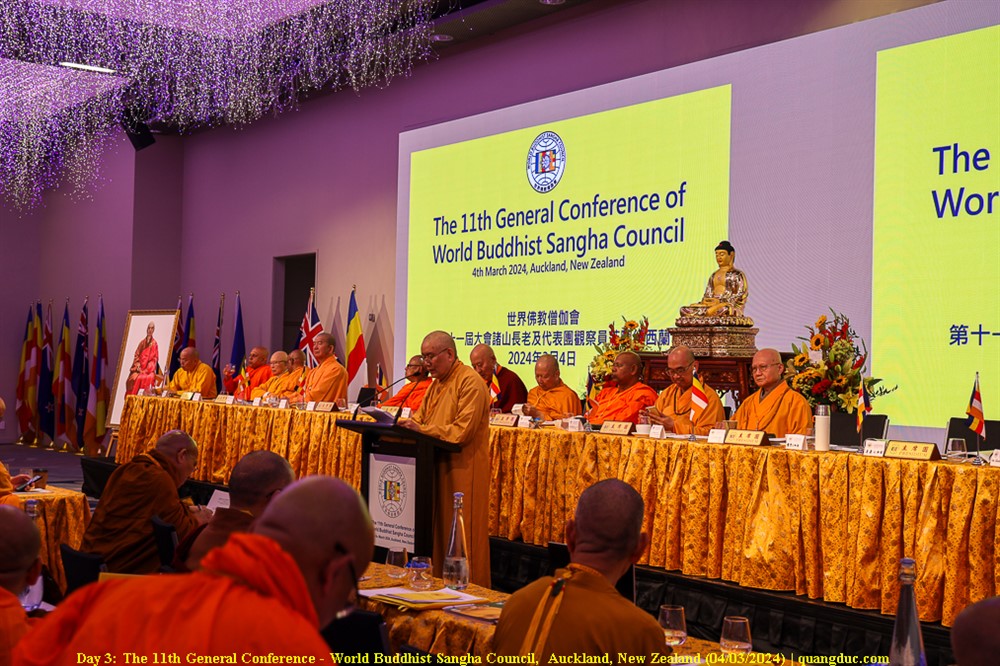
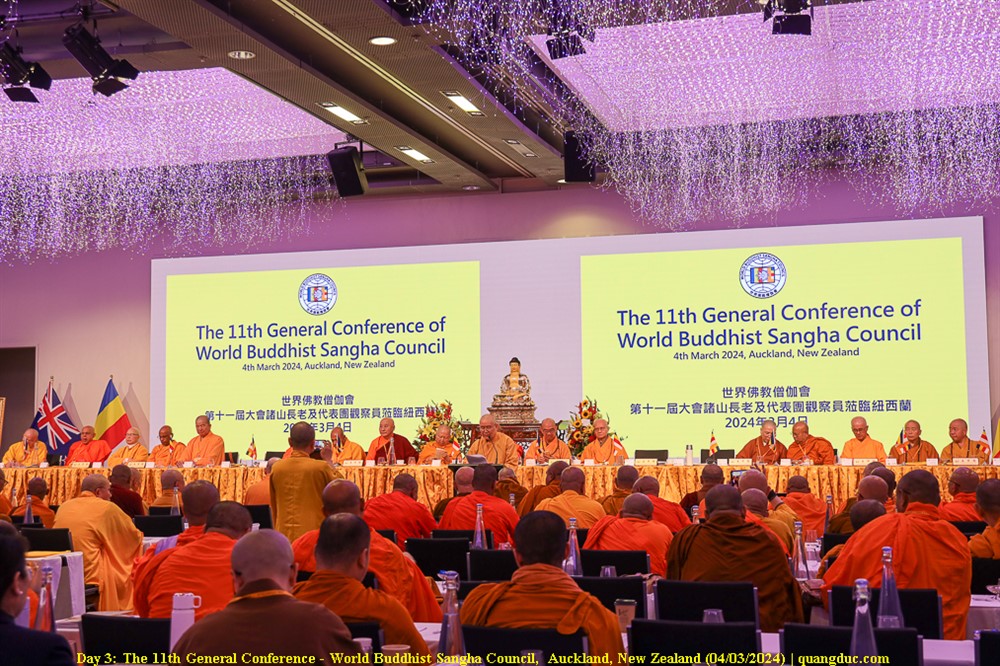
In every Buddhist country, both monastic and lay communities exist. In some, Buddhism became the state religion; yet until the mid-20th century, no global organization existed to unite monastics - or, more precisely, the worldwide monastic community. In 1966, in Colombo, Sri Lanka, the first World Buddhist Sangha Council was convened. Elder monks from across the globe gathered to establish the World Buddhist Sangha Council (WBSC). From Taiwan came Most Venerable Elder Bai Sheng and Wu Ming; from Hong Kong, Most Venerable Elder Jue Kuang; and from Vietnam, Most Venerable Elder Tam Chau. These Most Venerable Elders became the founding members of the World Buddhist Sangha Council. In 1969, the second World Buddhist Sangha Council was held at Vinh Nghiem Pagoda in Saigon, representing a great honor for Vietnamese Buddhists.

In the years that followed, many Buddhist countries successively hosted WBSC Executive Council Meetings and General Assemblies. To date, approximately twenty nations have held such gatherings, including Taiwan, Hong Kong, Singapore, Malaysia, Indonesia, Sri Lanka, Vietnam, Korea, Macao, and China—and extending farther to Australia, New Zealand, the United States, Canada, and Germany.

Buddhism in Germany was established roughly a century ago. In the early days, however, monks, nuns, and lay Buddhists participated together within a single organization called the ‘Deutsche Buddhistische Union’ (DBU). It was not until later—specifically, between 1977 and 2000, during my personal presence in Germany— that I proposed separating the monastic community from the lay community into two distinct organizations.

Today, visitors from abroad can observe that this organizational structure has been in place for about thirty years, under the name ‘Deutsche Buddhistische Ordensgemeinschaft’ (DBO). This faithfully reflects the spirit of the Buddha’s original teachings. It is a result that is both noteworthy and encouraging for Buddhism in Germany today.

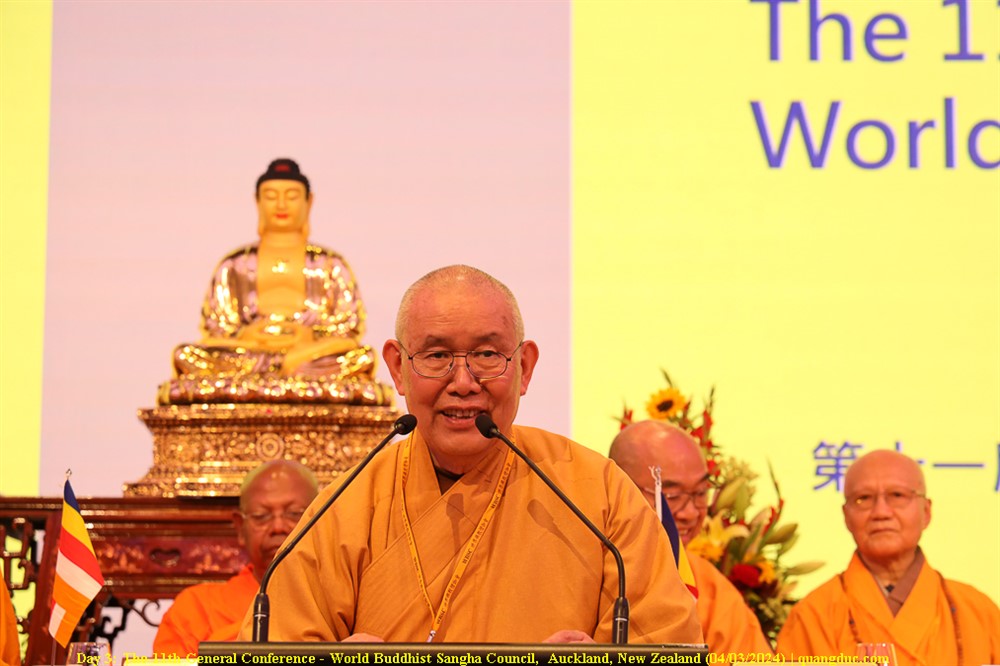
Over the past six decades, the World Buddhist Sangha Council has continued to grow and evolve under the leadership of its successive presidents: Most Venerable Elders Bai Sheng, Wu Ming, and Liao Chung. The current term is led by Most Venerable Elder Huei Hung. It is my heartfelt wish that Buddhism continues to reach ever more people across the globe, and that the World Buddhist Sangha Council’s activities receive increasing support and collaboration under the guidance of its Presidents, Vice Presidents, Secretaries (in both Chinese and English), and Executive Committee members representing more than thirty countries.

May peace prevail throughout the world,
and may all sentient beings live in happiness and harmony.


ht nhu dien-dai hoi tan gia-1ht nhu dien-dai hoi tan gia-2ht nhu dien-dai hoi tan gia-3ht nhu dien-dai hoi tan gia-4ht nhu dien-dai hoi tan gia-5ht nhu dien-dai hoi tan gia-0ht nhu dien-dai hoi tan gia-11

ht nhu dien-dai hoi tan gia-12

view next
Gửi ý kiến của bạn
Tắt
Telex
VNI
Tên của bạn
Email của bạn
07/09/2025(Xem: 815)
Offering Ceremony to the 73 Wisdom Buddhas by the Sri Lankan Buddhist Community in Darwin, Northern Territory, (Sunday, 7/9/2025) - Lễ Cúng Dường 73 vị Phật Trí Tuệ của cộng đồng Phật tử Tích Lan tại Darwin, Bắc Úc
05/05/2020(Xem: 9347)
When an organisation we care about doesn't have the level of support it should, it's often quite frustrating. I believe the Australian UN Vesak Day should be known and celebrated by ALL Buddhists and non-Buddhists in Australia, but it's not as well known as it should be. This is a heart-to-heart from me to you to highlight some of the biggest misconceptions I believe people generally have about the Australian UN Vesak Day (Australian Observance of the United Nations Day of Vesak), which impacts its participation level every year. It also invites you to the very first online celebration not just open to Australian Buddhists and non-Buddhists but for everyone internationally to come together in unity and solidarity to celebrate this auspicious day for ALL Buddhists and non-Buddhists alike to celebrate the Buddha's messages of peace and his devotion to the service of humanity.
01/05/2020(Xem: 9875)
The Buddhist Federation of Australia would like to express its sincere concern for the impact that the coronavirus (COVID-19) pandemic is having on the lives of people in Australia and around the world. We understand the levels of concern in the community caused by the health risks from the virus as well as the socio-economic crisis brought on by the significant reduction in employment and general social and commercial activities. We especially appreciate the dedication and professionalism of healthcare workers who put their lives at risk on the frontline in dealing with this crisis and we support the efforts and measures put in place by the government at this difficult and challenging time.
30/01/2020(Xem: 15703)
You are invited to a multifaith gathering to acknowledge Victoria’s bushfire crisis Join Victoria’s faith and political leaders for a special multifaith gathering on the steps of Parliament House on Tuesday 4 February 2020. Hosted by the Faith Communities Council of Victoria and the Multifaith Advisory Group (convened by the Victorian Multicultural Commission), the gathering will bring Victorians together to pray for those who have lost their lives and for the devastation of land, property and wildlife caused by the recent bushfires. Together, we will show our appreciation and say thanks to the firefighters, emergency services and volunteers for their dedication, bravery and service. We will also demonstrate our support for leaders on all sides of politics as they continue to lead our state through this unprecedented tragedy. With the fire season not yet over and with relief and recovery efforts expected to take months, if not years, this event will demonstrate the stren
07/04/2019(Xem: 7506)
PREFACE Avalokiteśvara is a female bodhisattva. There are many female Buddhists (upāsikā), but those who become sages or Buddhas are scarce. According to the Southern Buddhist tradition (Theravāda), there exists the Therīgāthā (Songs of the Elder Nuns), which consists of seventy-three stories about the lives, cultivation, strenuous effort, and realized experiences of the elder nuns who were female arahants or on the way to arahantship. From accounts in the Buddhist Mahāyāna tradition, there are many sūtras related to several female bodhisattvas, such as Mahāsthāmaprāpta and Avalokiteśvara. The latter is assumed to be the most unique as she is the Great Compassionate Mother. She endows sentient beings with pleasure and saves them from misfortune; in particular, she takes sounds as her contemplative object and deeply listens to sentient beings crying from the suffering in life. Thus, in the mind of every Buddhist, she is a perfect symbol of the Compassionate Goddess in Buddhism. T
30/03/2019(Xem: 14516)
Vesak Friendship Dinner -Saturday 30 March 2019 at Quang Minh Temple, Victoria
11/12/2018(Xem: 14025)
Social Values-In The Metta Sutta by_Dr. Bokanoruwe Dewananda
23/05/2018(Xem: 7473)
Dharma talk: Thoughts and Significance of Celebrating Buddha’s Birthday – Buddhist Calendar 2562 Buddha’s Birthday or Vesak Day, Buddhist Calendar 2562 is again returning to our earth, millions of Buddha’s followers from East to West; from Europe to Asia, with millions of hearts just as one, and with a single belief in joyfully welcoming this important day. That is the day when our World Honored One comes into existence with the great vow of Wisdom and Compassion, bringing peace and happiness for the majority; setting straight what is fallen down from net of hatred and ignorance, false beliefs; healing what is broken from ideologies of self-attachment and variations of mean selfishness; turning on the light for people to see “the original face” of themselves and showing them the way to escape from birth-death nights full of darkness.
22/05/2018(Xem: 60701)
The Buddhist community is extremely upset by the inappropriate and disrespectful use of the image of Buddha, The Buddhist community is extremely upset by the inappropriate and disrespectful use of the image of Buddha, in a display at the National Gallery of Victoria (NGV) entitled the 'Eternity-Buddha in Nirvana, the Dying Gaul, Farnese Hercules, Night, Day, Sartyr and Bacchante, Funerary Genius, Achilles, Persian Soldier Fighting, Dancing Faun, Crouching Aphrodite, Narcisse Couché, Othryades the Spartan Dying, the Fall of Icarus, A River, Milo of Croton'. It can also be seen at: https://www.ngv.vic.gov.au/explore/collection/work/131149/ Although this display has been in place for some months, we have only just been made aware of its' existence. We are not usually outspoken, but this display desecrates the image of Buddha by placing images of these mythical images on him and in doing so, showing no apparent regard or respect for Him.
07/05/2018(Xem: 6579)
The 2018 Australian Observance of the United Nations Day of Vesak, commemorating the birth, enlightenment and passing away of The Lord Buddha was held at Paul Keating Park in Bankstown, New South Wales on Saturday May 5, and was well attended by hundreds of enthusiastic and happy Buddhists and Non-Buddhists from around Sydney, and from around Australia. The formal proceedings of this most auspicious event began at 10am with a warm welcome from the MC's and traditional Buddhist chanting in the Pali, Vietnamese, Tibetan and English languages, by representatives from the monastic communities of the three major Buddhist traditions of Theravada (School of the Elders), Mahayana (Great Vehicle) and Vajrayana (Diamond Vehicle).