
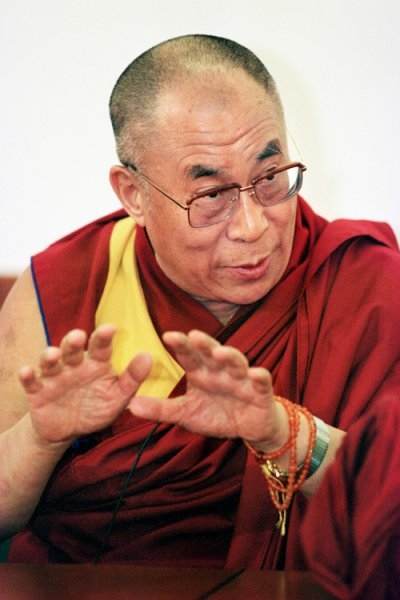
His Holiness the 14th Dalai Lama

MESSAGE
I extend my greetings to participants of the 11th Anniversary Celebrations and International Buddhist Conference on the United Nations Day of Vesak 2014, being hosted by the National Vietnam Buddhist Sangha (NVBS).
For Buddhists across the world, Vesak is a day when we not only honour and celebrate the Buddha's birth, enlightenment and Mahaparinirvana, but also remind ourselves of the importance of leading our lives in accordance with his noble teachings.
Buddha Shakyamuni attained enlightenment and taught in India over two thousand years ago, yet his teachings remain refreshing and relevant even in today’s world. Today, for example, there is a growing global awareness of the importance of non-violence. Its application is not restricted merely to other human beings, but also has to do with ecology, the environment and our relations with all the other living beings with whom we share the planet. Non-violence thus can be applied in our day-to-day lives whatever our position or vocation.
The purpose of life is to be happy. As a Buddhist I have found that our own mental attitude is the most influential factor in working towards that goal. In order to change conditions outside ourselves, whether they concern the environment or relations with others, we must first change within ourselves. Inner peace is the key. In that state of mind you can face difficulties with calm and reason, while retaining your inner happiness. The teachings of love, kindness and tolerance, the conduct of nonviolence, the Buddhist theory that al! things are relative, as well as a variety of techniques for calming the mind are a source of that inner peace.
I believe Buddhism has an important role to play in our modern world; its concept of interdependence accords closely with fundamental notions of modern science. We can think of Buddhism in terms of three main categories - philosophy, science and religion. The religious part involves principles and practices that are of concern to Buddhists alone, but the Buddhist philosophy of interdependence as well as the Buddhist science of mind and human emotions are of great benefit to everyone. As we know, modern science has developed a highly sophisticated understanding of the physical world, including the subtle workings of the body and the brain. Buddhist science on the other hand, has devoted itself to developing a detailed, first-person understanding of many aspects of the mind and emotions, areas still relatively new to modern science. Each therefore has crucial knowledge with which to complement the other. I believe that a synthesis of these two approaches has great potential to lead to discoveries that will enrich our physical, emotional and social well-being.
Until the last fifty years or so, the world's diverse Buddhist communities had only a distant inkling of each other's existence and little appreciation of how much they held in common. As the Buddha's teaching took root in different places, certain variations in the style in which it was practised and upheld evolved naturally. However, I believe that time has now come to communicate freely with one another; after all, our various Buddhist traditions are but branches springing from a common trunk and roots. May I therefore appeal to this assembly of esteemed Buddhist elders and representatives to take this opportunity to improve and extend communications amongst ourselves, in order that the Buddhist community as a whole will be able to contribute more effectively to human happiness and peace of mind throughout the world.
March 26, 2014
Source:
http://www.undv2014vietnam.com/vn/
Gửi ý kiến của bạn



%7Cutmcsr%3D(direct)%7Cutmcmd%3D(none)%3B%2B__utmv%3D114758214.-%3B)