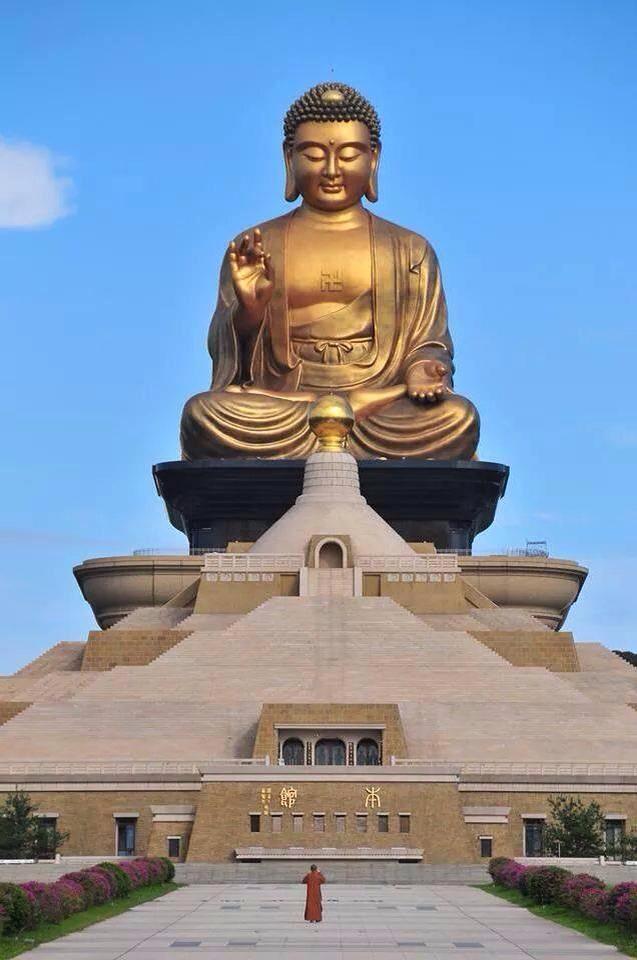
Why I love Buddhism

01/03/201722:16(Xem: 18962)
Why I love Buddhism
Phat Thich Ca 2

WHY I LOVE BUDDHISM

Recently I was asked why I love Buddhism. So here are 7 answers for why I love, appreciate, respect, study, practise and share the precious Buddha Dharma.
 Some answers are short and sweet, while others are in more detail. Of course I could give many more answers and more details, however I've kept it to just 7, for the benefit of easy reading. 

Answer #1 
The Buddha Dharma is the only path that leads to the realisation of the fruit of unsurpassed supreme enlightenment. Along the way we experience the fields of bliss caused by our fields of merit. Ultimate bliss is realised when we attain unsurpassed supreme enlightenment.

Answer #2
Practising Buddha Dharma enables us to get to know our mind, which is the source of all of our experiences. 

Answer #3
Not only does Buddha Dharma answer all of the important questions in life. If we wholeheartedly practise, we ourselves will directly realise both relative and ultimate truth.

Answer #4
We have the freedom to think, act and speak. We have the freedom and potential to learn and practise. We have the freedom, potential and ability to awaken transcendent wisdom and a great heart of compassion, and attain unsurpassed supreme enlightenment.
 
I would like to share with you that in my youth, I was very deeply inspired to wholeheartedly practise the Buddha Dharma, for the benefit of all sentient beings, by the following well known words of the Buddha. May you too be inspired to wholeheartedly practise the Buddha Dharma, for the benefit of all sentient beings.

-Do not believe in anything (simply) because you have heard it.
Do not believe in traditions because they have been handed down for many generations.                                                 Do not believe in anything because it is spoken and rumoured by many.                  Do not believe in anything (simply) because it is found written in your religious books.                                Do not believe in anything merely on the authority of your teachers and elders.                                             But after observation and analysis, when you find that anything agrees with reason and is conducive to the good and benefit of one and all then accept it and live up to it.

-We are what we think.
All that we are arises with our thoughts.
With our thoughts we make the world.
Speak or act with an impure mind
And trouble will follow you
As the Wheel follows the ox that draws the cart.

We are what we think.
All that we are arises with our thoughts.                                       With our thoughts we make the world.                                         Speak or act with a pure mind       And happiness will follow you.         As your shadow, unshakeable.

-Thus shall ye think of all this fleeting world; A star at dawn, a bubble in a stream, a flash of lightning in a summer cloud, a flickering lamp, a phantom, and a dream. 

Answer #5.                                     The Buddha Dharma is inclusive, not exclusive. Our aim is to benefit all sentient beings, without exception. To help all sentient beings, including ourselves, to have happiness and its causes, and to be free from suffering and it's causes, and to attain unsurpassed supreme enlightenment as swiftly as possible. 

The Buddha Dharma transcends colour, texture, flavour, language, culture, tradition and nationality. It is for everyone, everywhere and at any time. 

This is especially evident in the practise of the Four Immeasurable's (Brahma Vihara) of universal loving kindness (metta), universal compassion (karuna), empathetic joy (mudita) and equanimity or non-bias (uppekkha). 

May you all be happy and free from suffering, and attain unsurpassed supreme enlightenment as swiftly as possible.

Please see more words of inspiration below from the great Indian master Shantideva's Bodhicaryavatara (The Way of the Bodhisattva) (From the chapter on 'Commitment'). 

From verse 7 to 10:

'.....By the virtue I have just amassed, 
May all the pain of every living being
Be wholly scattered and destroyed. 

For all those ailing in the world, 
Until their every sickness has been healed, 
May I myself become for them
The doctor, nurse and medicine itself. 

Raining down a flood of food and drink, 
May I dispel the ills of thirst and famine. 
And in the ages marked by scarcity and want, 
May I myself appear as drink and sustenance. 

For sentient beings, poor and destitute,
May I become a treasure ever plentiful, 
And lie before them closely in their reach, 
A varied source of all that they might need.....'

From verse 18 to 22:

'.....May I be a guard for those who are protectorless, 
A guide for those who journey the road, 
For those who wish to go across the water,
May I be a boat, a raft, a bridge. 

May I be an isle for those who yearn for landfall, 
And a lamp for those who long for light;
For those who need a resting place, a bed;
For all who need a servant, may I be their slave. 

May I be the wishing jewel, the vase of plenty, 
A word of power and the supreme healing;
May I be the tree of miracles, 
And for every being the abundant cow. 

Like the earth and the pervading elements, 
Enduring as the sky itself endures, 
For boundless multitudes of living beings, 
May I be their ground and sustenance. 

Thus for everything that lives, 
As far as are the limits of the sky, 
May I provide their livelihood and nourishment
Until they pass beyond the bonds of suffering.....'

Answer #6                                            

To bring about the awakening of students of all temperaments, the Buddha taught a wonderful variety of spiritual practises. There are foundation practises for the development of loving kindness, generosity and moral integrity. Then there is a vast array of meditation practises to train the mind and open the heart. These practises include awareness of the breath and body, mindfulness of feelings and thoughts, practises of mantra and devotion, visualisation and contemplative reflection, and practises leading to refined and profoundly expanded states of consciousness.

We sentient beings are all different in one way or another. All at different stages on our spiritual journey, our path to enlightenment. Therefore, we should seek to receive instructions on the particular methods, as taught by the Buddha, that are suitable to our current individual temperaments and needs, and wholeheartedly put them into practise.

Furthermore, we all have the potential to avoid all extremes and practice the middle path, the Noble Eight-Fold Path, which consists of perfect understanding, thought, speech, action, livelihood, effort, mindfulness and concentration. 
 
We all have the potential to practise the Dharma, to develop immeasurable love and compassion, realise perfect wisdom, and to attain unsurpassed supreme enlightenment. 
Answer #7
The Buddha recommends, invites and encourages all who are interested to thoroughly investigate, analyse and test the Dharma teachings. Just as a goldsmith tests for real gold. Not to just believe in them with blind faith.

He then advises us to wholeheartedly put them into practise and to work diligently towards realising the result of the Dharma path, enlightenment. 

If we do as he recommends, we will realise that his teachings are very clear and that they make perfect sense. That they are perfectly logical when tested with critical analysis and that they are in accord with modern scientific findings. In more than 2,600 years they have never been proven wrong. 

Take for instance the Buddhist belief in the Law of Karma, which is a view that has been checked and analysed by many great practitioners and realised masters. Conviction in its validity is gained through logical reasoning. It should not simply be followed blindly. 

Any action of body, speech, or mind, places an imprint, an 'energy potential' or 'seed' in the mind. Mental seeds are planted through your awareness of what you do, say or think. The imprints of these actions are left on the mind stream and carried on moment by moment - the present moment of mind coming from the previous moment of mind.

When the necessary supporting conditions are in place, this imprint, or latent potency, manifests as perceptions or experiences of happiness or suffering. We can liken this to a biological seed, which ripens when the contributing causes and conditions of water, soil, sun, and the like are gathered together.

May we all realise the foundation, path and result of the path, & swiftly attain unsurpassed supreme enlightenment.

Please enjoy the following quotes about the Buddha Dharma from Albert Einstein:

- 'Science without religion is lame. Religion without science is blind.'

- 'Buddhism requires no revision to keep it up-to-date with recent scientific finding.'

- 'Buddhism does not need to surrender its views to science, because it embraces science as well as goes beyond science.'

- 'The religion of the future will be a cosmic religion. It should transcend personal gods, and avoid dogma and theology. Covering both the natural and the spiritual, it should be based on a religious sense arising from the experience of all things, natural and spiritual, as a meaningful unity. Buddhism answers this description.'

- 'If there is any religion that could cope with modern scientific needs, it would be Buddhism.'

And the following quote from historian, Arnold Toynbee:

- 'The coming of Buddhism to the west may well prove to be the most important event of the 20th century.'
 
May these 7 answers be in some way helpful and beneficial to all sentient beings. 
 
May they inspire you to study, practise and share the Buddha Dharma to the best of your ability. 
 
May the Buddha Dharma flourish throughout infinite space. 
 
May all sentient beings attain unsurpassed supreme enlightenment as swiftly as possible. 
 
By Dharma Teacher Andrew Williams 
Gửi ý kiến của bạn
Tắt
Telex
VNI
Tên của bạn
Email của bạn
14/05/2015(Xem: 29338)
Amitabha Buddha’s name chanting is an easy method of cultivation in which beliefs are difficult to have, especially in this age of information technology when people care more about material comfort than the spiritual life. However, as in the Buddha’s teachings: Buddhahood is a nature of mind and it’s the mind that possesses the Buddhahood, ringing about enlightenment. Therefore, as Buddhists, we have to believe in Buddha’s teachings. The Flower Adornment Sutra stated: “Beliefs are the mother of all the good merits.”. No other merits are greater than making a vow to be reborn in the Pure Land and to become a Buddha. On the occasion of this year’s retreat, we would like to briefly tell you about an old lady having a belief in Amitabha Buddha’s name chanting
21/11/2014(Xem: 27190)
As a Vietnamese Buddhist monk serving as a Buddhist chaplain in several hospitals across Melbourne, as well as at the Melbourne Assessment Prison, I have witnessed numerous personal tragedies experienced by the living, along with the profound realities of dying and death. Many individuals, especially those approaching the end of life, often face their final moments with fear, suffering, and deep emotional pain. Bearing these experiences in mind, I would like to share some reflections from a Buddhist perspective. It is my sincere hope that such understanding may help ease the fear surrounding death and allow individuals to approach this inevitable transition with greater calmness and acceptance. For, according to the Buddhist view, death is not the end of life, but rather a continuation within the cycle of existence.
17/04/2014(Xem: 17416)
Sampson "Sam" Gordon Berns (October 23, 1996 – January 10, 2014) was an American who suffered from progeria and helped raise awareness about the disease.He was the subject of the HBO documentary Life According to Sam.[1][3] His parents, Scott Berns and Leslie Gordon, both pediatricians, received their son's diagnosis when he was less than two years of age.[4] Roughly a year later, they established the Progeria Research Foundation[5] in an effort to increase awareness of the condition, to promote research into the underlying causes of and possible treatments for the disease, and to offer resources for the support of sufferers and their families.Sam Berns is a Junior at Foxboro High School in Foxboro, Massachusetts, where he has achieved highest honors and is currently a percussion section leader in the high school marching band. He recently achieved the rank of Eagle Scout in the Boy Scouts of America. Sam was diagnosed with Progeria, a rare, rapid aging disease, at the age of 2. He
28/02/2014(Xem: 11141)
Books on Buddhism often state that the Buddha's most basic metaphysical tenet is that there is no soul or self. However, a survey of the discourses in the Pali Canon -- the earliest extant record of the Buddha's teachings -- suggests that the Buddha taught the anatta or not-self doctrine, not as a metaphysical assertion, but as a strategy for gaining release from suffering.
09/04/2013(Xem: 46540)
Yae-Hong Hsu, better known by his Buddhist name Chin Kung Shi, was born in February of 1927 in Lujiang County, Anhui Province of China. He attended the National Third Guizhou Junior High School and Nanjing First Municipal High School. In 1949, he went to Taiwan and worked in the Shijian Institution.
08/04/2013(Xem: 6634)
When Buddhism first entered China from India and Central Asia two thousand years ago, Chinese favourably disposed towards it tended to view it as a part or companion school of the native Chinese Huang–Lao Daoist tradition, a form of Daoism rooted in texts and practices attributed to Huangdi (the Yellow Emperor) and Laozi. Others, less accepting of this ‘foreign’ incursion from the ‘barbarous’ Western Countries, viewed Buddhism as an exotic and dangerous challenge to the social and ethical Chinese civil order.
10/11/2012(Xem: 5434)
...To understand emptiness we must apply the four point analysis. The first point is to identify clearly the object-to-be-negated. The second point is to understand the 'entailment' of the argument, that is to ascertain conclusively the possible whereabouts of the object-to-be-negated.
21/01/2012(Xem: 16245)
Sometimes we are moved by the things we don't say aloud. Sometimes it's just a matter of perspective. Well, this truly inspiring video says a lot without saying anything at all.Sometimes we are moved by the things we don't say aloud. Sometimes it's just a matter of perspective. Well, this truly inspiring video says a lot without saying anything at all.Harness the power of words to grow your business today: http://tinyurl.com/phokf69 For personal transformation order Andrea Gardner's book 'Change Your Words, Change Your World' at http://amzn.to/xfrT2U To use this video in a commercial player, advertising or in broadcasts, please email Viral Spiral: [email protected] Homage to Historia de un letrero, The Story of a Sign by Alonso Alvarez Barreda Music by: Giles Lamb http://www.gileslamb.com Filmed by www.redsnappa.com Director Seth Gardner. Cast: Bill Thompson, Beth Miller http://www.uk.castingcallpro.com/view... Follow Purplefeather on Facebook: http://facebook.com/purpl
30/09/2011(Xem: 6390)
When we took a cognitive perspective, we would offer insight. Cognitive involves the formation of the concepts, schemas, theories, and other mental abstractions.
25/09/2011(Xem: 11608)
It is a fundamental fact of human existence, His Holiness said, that the development of a healthy body and sound mind derives originally from the loving care that one receives from one's mother.
