
Questions about practicing Buddhism in Australia
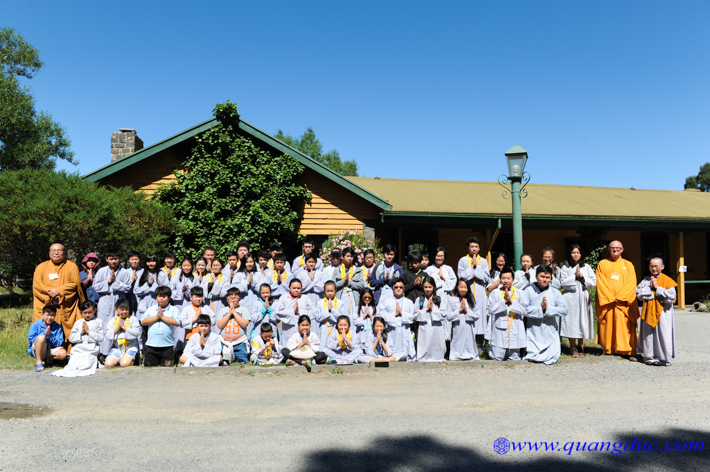
(From Vietnamese Buddhist students at the Summer Retreat in Kyneton,
Victoria, Australia, 29 December 2016 to 2 January 2017)
By Andrew Williams
1/ How does reincarnation work in Buddhism?
Answer: All of our experiences, both mental and physical, including this life, as well as previous and future lives, are caused by our actions (karma) of body, speech and mind in the past & present. Good actions produce desirable results, a good rebirth and life conditions. Whereas bad actions produce undesirable results, a bad rebirth and life conditions. We are continually reborn, according to the results of our karma, in samsara (cyclic existence), until we realise the ultimate truth of enlightenment.
2/ When we pray who do we pray to? And the words we say when praying what do they mean?
Answer: When we pray to the Buddha's and Bodhisattva's, we are doing so to absorb our mind with the Dharma teachings. To develop the mental conditions that will enable us to gain genuine insight into the meaning of the teachings. For us to be able to purify our mind by enthusiastically and joyfully practising the Dharma accurately, with pure intention.
We should do our very best to mindfully recite important prayers and verses such as homage, refuge and the like, as well as important teachings of the Buddha, and commit them to memory, so that we can recall and access them at anytime and anywhere.
We should contemplate the meaning and develop genuine understanding of these immeasurably precious teachings, and then habituate our mind with genuine insight into the meaning of the words, verses and teachings that we are reciting.
When we mindfully recite verses and teachings, we are engaging our whole being, our speech, our body and our mind.
Of course the mind is the chief, for it is the mind that will understand and realise the purpose, methods, practise of the methods and result of the practise.
Study, recite, remember, practise and share the Dharma well, and eventually you will understand and realise the unification and perfection of inseparable wisdom and method, and attain unsurpassed supreme enlightenment.
3/ Have you ever been in love?
Answer: Yes, a few times when I was much younger, but only fleetingly. It didn't last long. All conditioned things, such as falling in love are subject to constant change.
Actually, it is important to note that there are different kinds of love; parental love, romantic love, endearing love, possessive love, and unconditional love.
Parental, romantic, endearing and possessive love are all conditioned and subject to change.
Unconditional love (Metta), which can also be known as universal love or immeasurable love, is the love that we aim to perfect in Buddhism. It is the love and care that wishes that all living beings, without exception, have happiness and the causes of happiness, and that we all attain enlightenment.
4/ In the future when treating patients how can I use Buddhism to help me?
Answer: All aspects of Buddhism will help when you are treating patients. For instance, true wisdom and understanding, along with true love and compassion, will help when dealing with the varying personalities and medical conditions of the patients, as well as with the processes of medical examination, diagnosis, prognosis, treatment plan and the implementation of the treatment plan, and so on and so forth.
Furthermore, you will benefit yourself and your patients by engaging in the practise of the six paramita's. Namely; generosity, morality, patience, enthusiastic effort, concentration and wisdom.
The Buddha Dharma will guide you as you guide your patients. Maintain a calm and clear mind, free from worry and agitation, and maintain pure intention.
5/ If good and bad are all relative to a person, let’s say, to a terrorist bomber, what they are doing is a good thing, but to others it is not. So that would mean right and wrong is relative too. So how do we know that something is an ‘absolute’ right thing who says that this is right and that is wrong.
Answer: The Lord Buddha said, "We are what we think. All that we are arises with our thoughts. With our thoughts we make the world. Speak or act with an impure mind, and trouble will follow you, as the wheel follows the ox that draws the cart."
"We are what we think. All that we are arises with our thoughts. With our thoughts we make the world. Speak or act with a pure mind, and happiness will follow you, as your shadow, unshakable."
Therefore, we should do our very best to speak and act with a pure mind, and avoid speaking and acting with an impure mind. We should have faith and confidence in ourselves to be able to live this way.
Avoid activities of the mind, body and speech that cause harm and trouble. Engage only in activities of the mind, body and speech that are helpful and bring benefit to all. Of utmost importance is our intention.
6/ As a practising Buddhist lay person how can I reconcile my desire to be successful/ambitious/career-driven with the Buddhist concept of right livelihood. Sometimes it feels like the pursuit of being successful career-wise is very wordly, driven by materialism. Can I be a decent Buddhist AND a successful career person. Is this possible?
Answer: Yes of course you can be a good Buddhist practitioner and have a successful career.
It is important to engage in thoughts, actions and words, which includes our chosen career or livelihood, that avoid harming ourselves and others, and only bring benefit to ourselves and others.
Right livelihood means to abstain from trading in anything that would bring harm. For example: Do not trade in (a) Human beings (slavery, prostitution and the like, (b) Flesh (breeding animals for slaughter and the like), (c) Intoxicants (alcohol and drugs), (d) Poisons, (e) Weapons.
Our intention is of utmost importance. So maintain pure intentions and always remember that virtue should always outweigh material gain. Listen to your conscience and be honest to yourself, and if you have doubts, ask a trusted virtuous friend such as your Dharma teacher for guidance.
7/ As a Buddhist monastic/ practitioner, can you recommend some useful and practical strategies on how to overcome things like a panic attack/anxiety attack. Can you offer some strategies on how to deal with a situation when these feelings arise and some tips on how to minimisenthese feelings/situations from arising.
Answer: Firstly, may I suggest that you read my article 'Meditation And It's Benefits - Getting To Know Your Mind', which you can easily access in both English and Vietnamese onquangduc.com. You should practise meditation. There is some meditation instruction in the article. This will help for sure.
We are intimately connected with all of nature. It is most important to realise this. For if we know this fact then we are more likely to coexist with all living beings and all of nature in a peaceful and harmonious way.
Many of our worries, discontent, agitation and feelings of being disconnected arise due to not realising this natural truth. We should open our minds and be less self-centred.
Take for example a camera. When the camera's focus is set on close-up, all we see through the lens is the close-up. Nothing else is seen. This is like when we are self-centred. We are focusing on ourselves, our problems and discontent, our likes and dislikes, and so on and so forth. At this time they are like the whole universe and nothing or no one else matters or exists.
But the more we widen and open the focus of the camera's lens, the more views and wider perspective of all that is around us is available to our vision. Likewise, the more we widen our focus, widen our view, open our mind, the more we allow ourselves the opportunity to develop genuine insight into ourselves, others and all of nature, and be at peace and in harmony with ourselves and all that surrounds us.
8/ Every morning when I read the news, there are so many reports on war and destruction happening all over the world. This sometimes leads me to feel overwhelmed, helpless and somewhat guiltyfor the relatively peaceful life I have. How do Itransform these feelings of sadness, anger and helplessness into something a lot more productive and constructive?
Answer: Firstly, I must say that it is very good and commendable that you are concerned for the welfare of others. Although do your very best to replace your feelings of sadness, anger, helplessness and guilt with compassion, love and a sense of responsibility based on understanding.
Peace must firstly be developed internally, in our own mind and then expressed outwardly through our actions and words. We must live by example. Thinking, acting and speaking with the motivation to cause and maintain peace, harmony and understanding. Then peace can be caused and realised, and the lack of peace can be overcome.
When a pebble is thrown into a pond, the ripples that are created cover all parts of the pond, likewise every thought, action and word effects everything.
So we should think, act and speak with universal love, compassion, joy and equanimity. This way we can contribute to peace in the world and have a positive influence on others to do likewise.
****

%7Cutmcsr%3D(direct)%7Cutmcmd%3D(none)%3B%2B__utmv%3D613085664.-%3B)