Vesak Friendship Dinner 2017

20/03/201707:01(Xem: 11524)
Vesak Friendship Dinner 2017
phatdansinh_2013
Vesak
 Friendship Dinner 2017


Dear Venerable Sangha,
Committees, Members and Communities
Friends in the Buddha Dhamma
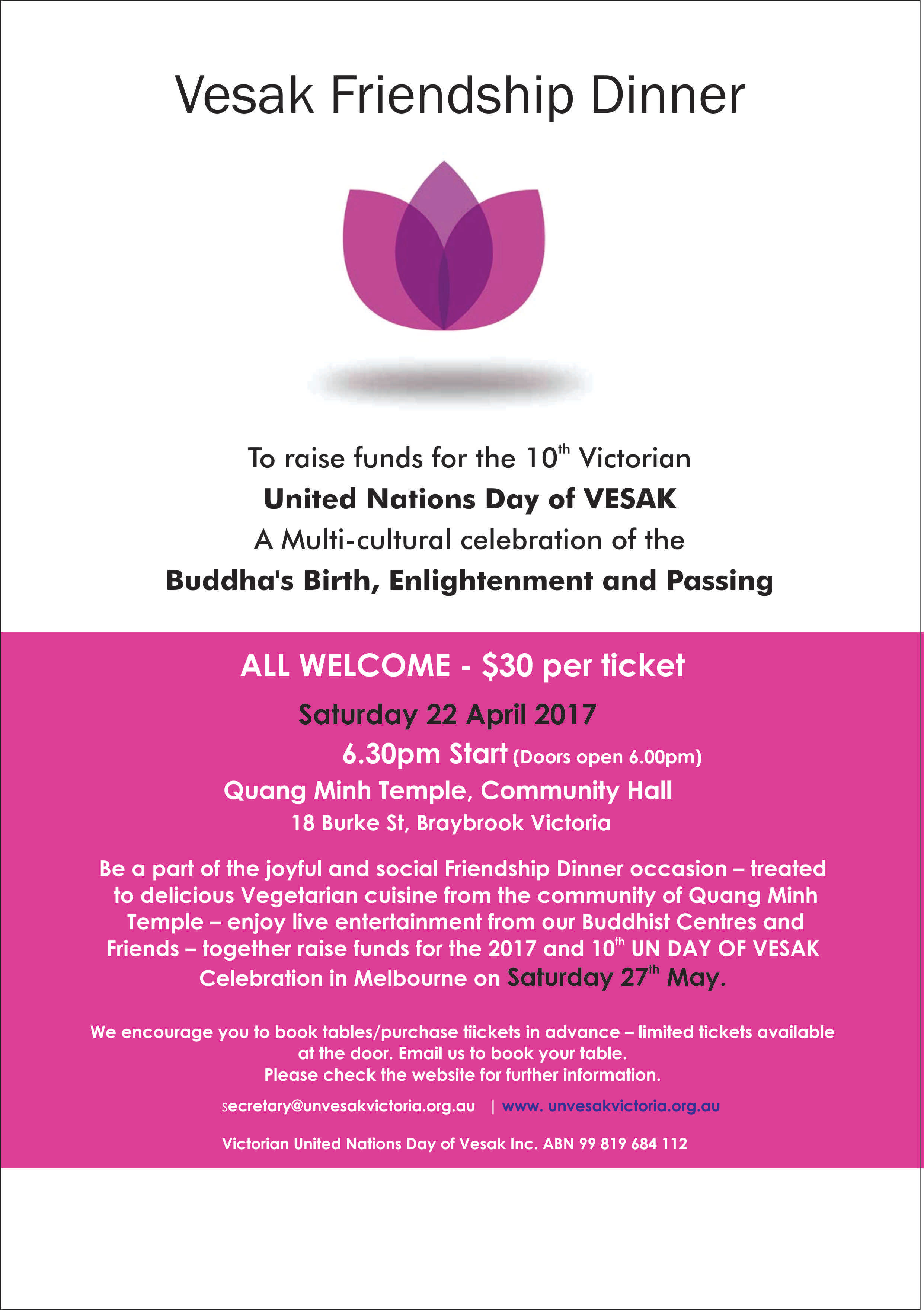
We warmly invite you to be part of the Vesak Friendship Dinner at Quang Minh Temple on Saturday 22nd April.

Below for you is the Vesak Friendship Dinner flyer.  Please print out, display and circulate among your community for everyone to come along... 
 
Book Your Tickets and Tables Today 
The Vesak Friendship Dinner brings our diverse and growing VictorianBuddhist community together for a social evening, vegetarian cuisine  and traditional and cultural performances by groups from across Melbourne.

Vesak Friendship Dinner 2017

Our Friendship Dinner is also the main fundraising event for the 10th annual Victorian United Nations Day of Vesak.

To held in the City of Melbourne on Saturday 27 May.  

It is a unique event providing a rare opportunity for our VictorianBuddhist community to come together as one to Commemorate the Birth, Enlightenment and Passing of the Lord Buddha.

We will be honored to have your Buddhist community join with us for this unique and rare event.


In coming weeks we will send you more information on the 2017 UN Day of Vesak program; as well as updating our website and Facebook pages.

Our Victorian Vesak commemoration begins on the morning of 27th of May with:
  • Offering of lunch to the Venerable Monks and Nuns at St Peters Church Hall in East Melbourne.
  • Vesak Procession at 1pm from Parliament Gardens to Collins Street; and at 1.30pm the...
  • UN Day of Vesak Commemoration and Celebration in the Melbourne Town Hall.
Thank you for your kind support, with the wish that we share these unique Vesak celebrations together.


Yours warmly

Julian Bamford
President 
Victorian United Nations Day of Vesak Inc.
M 0400 267 330
secretary@unvesakvictoria.org.au / julianb.mcsc@gmail.com

***

Vesak Day 2016: Photos of colourful celebrations of Buddha's birthday, enlightenment and death
Vesak_Victoria_Australia_2640_2016 (1)

(Next)

Gửi ý kiến của bạn
Tắt
Telex
VNI
Tên của bạn
Email của bạn
28/02/2014(Xem: 8274)
The two crucial aspects of the Buddha's Awakening are the what and the how: what he awakened to and how he did it. His awakening is special in that the two aspects come together. He awakened to the fact that there is an undying happiness, and that it can be attained through human effort.
28/02/2014(Xem: 7536)
The Buddha was like a doctor, treating the spiritual ills of the human race. The path of practice he taught was like a course of therapy for suffering hearts and minds. This way of understanding the Buddha and his teachings dates back to the earliest texts, and yet is also very current.
28/02/2014(Xem: 8930)
There are three fundamental modes of training in Buddhist practice: morality, mental culture, and wisdom. The English word morality is used to translate the Pali term sila, although the Buddhist term contains its own particular connotations. The word sila denotes a state of normalcy, a condition which is basically unqualified and unadulterated.
28/02/2014(Xem: 7564)
According to the Buddhist monastic code, monks and nuns are not allowed to accept money or even to engage in barter or trade with lay people. They live entirely in an economy of gifts. Lay supporters provide gifts of material requisites for the monastics, while the monastics provide their supporters with the gift of the teaching.
28/02/2014(Xem: 8467)
This year, at the summer retreat, Vien Tu and Minh Hanh, the two novice monks, took turns to prepare the congee offering each evening. Many Buddhists were curious to know why the congee was offered but not the cooked rice or others. This article is writing about the congee services to the spirits.
28/02/2014(Xem: 10196)
According to the Oxford English Dictionary the word ‘chant’ is both a noun and a verb, also (now Scottish) chaunt, compared with the late 17th Century, old and modern French verb, ‘with chant’ which is derived from the Latin, ‘cantum’.
28/02/2014(Xem: 7098)
My dear friends, suppose someone is holding a pebble and throws it in the air and the pebble begins to fall down into a river. After the pebble touches the surface of the water, it allows itself to sink slowly into the river. It will reach the bed of the river without any effort. Once the pebble is at the bottom of the river, it continues to rest. It allows the water to pass by.
28/02/2014(Xem: 7472)
We all know what happens when a fire goes out. The flames die down and the fire is gone for good. So when we first learn that the name for the goal of Buddhist practice, nibbana (nirvana), literally means the extinguishing of a fire, it's hard to imagine a deadlier image for a spiritual goal: utter annihilation.
28/02/2014(Xem: 6439)
This script was written and edited by: John D. Hughes, Arrisha Burling, Frank Carter, Leanne Eames, Jocelyn Hughes, Lisa Nelson, Julie O’Donnell, Nick Prescott, Pennie White and Lenore Hamilton. Consider a water tank as a model of understanding. When the water in the tank gets too low, you get sick and eventually die. For you to stay alive, the tank must be consistently replenished with water.
28/02/2014(Xem: 6227)
When we do walking meditation, the point is not to get somewhere, but rather to practice, using walking as the object of our attention. Even when we do have to get somewhere and must drive to do so, there is an opportunity for practice. Thich Nhat Hanh, Vietnamese Zen master and poet, has written a number of gathas, or brief verses, for enhancing our mindfulness during everyday activities, even driving a car.