Mangala Sutra

25/02/202605:41(Xem: 21)
Mangala Sutra


Phat thuyet phap 7
dewananda
Maha Mangala Sutta
Life’s Highest Blessings, The Sutra on Happiness, the Tathagata’s Teaching to Gods and Men
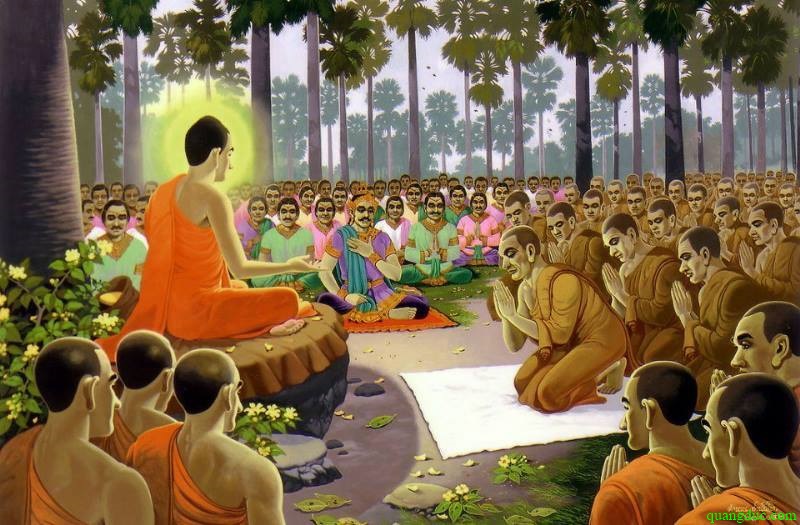

I heard these words of the Buddha one time when the Lord was living in the vicinity of Savatthi at the Anathapindika Monastery in the Jeta Grove. Late at night, a deva appeared whose light and beauty made the whole Jeta Grove shine radiantly. After paying respects to the Buddha, the deva asked him a question in the form of a verse:


“Many gods and men are eager to know
what are the greatest blessings
which bring about a peaceful and happy life.
Please, Tathagata, will you teach us?”


(This is the Buddha’s answer):


“Not to be associated with the foolish ones,
to live in the company of wise people,
honoring those who are worth honoring —
this is the greatest happiness.


“To live in a good environment,
to have planted good seeds,
and to realize that you are on the right path —
this is the greatest happiness.


“To have a chance to learn and grow,
to be skillful in your profession or craft,
practicing the precepts and loving speech —
this is the greatest happiness.


“To be able to serve and support your parents,
to cherish your own family,
to have a vocation that brings you joy —
this is the greatest happiness.


“To live honestly, generous in giving,
to offer support to relatives and friends,
living a life of blameless conduct —
this is the greatest happiness.


“To avoid unwholesome actions,
not caught by alcoholism or drugs,
and to be diligent in doing good things —
this is the greatest happiness.


“To be humble and polite in manner,
to be grateful and content with a simple life,
not missing the occasion to learn the Dharma —
this is the greatest happiness.


“To persevere and be open to change,
to have regular contact with monks and nuns,
and to fully participate in Dharma discussions —
this is the greatest happiness.


“To live diligently and attentively,
to perceive the Noble Truths,
and to realize Nirvana —
this is the greatest happiness.


“To live in the world
with your heart undisturbed by the world,
with all sorrows ended, dwelling in peace —
this is the greatest happiness.


“For he or she who accomplishes this,
unvanquished wherever she goes,
always he is safe and happy —
happiness lives within oneself.”


Mahamangala Sutta, Sutta Nipata 1


vietnam

Gửi ý kiến của bạn
Tắt
Telex
VNI
Tên của bạn
Email của bạn
24/04/2019(Xem: 14736)
Chanting - The Heart Sutra in English - Su Co Giac Anh
11/12/2018(Xem: 14053)
Social Values-In The Metta Sutta by_Dr. Bokanoruwe Dewananda
22/05/2018(Xem: 60985)
The Buddhist community is extremely upset by the inappropriate and disrespectful use of the image of Buddha, The Buddhist community is extremely upset by the inappropriate and disrespectful use of the image of Buddha, in a display at the National Gallery of Victoria (NGV) entitled the 'Eternity-Buddha in Nirvana, the Dying Gaul, Farnese Hercules, Night, Day, Sartyr and Bacchante, Funerary Genius, Achilles, Persian Soldier Fighting, Dancing Faun, Crouching Aphrodite, Narcisse Couché, Othryades the Spartan Dying, the Fall of Icarus, A River, Milo of Croton'. It can also be seen at: https://www.ngv.vic.gov.au/explore/collection/work/131149/ Although this display has been in place for some months, we have only just been made aware of its' existence. We are not usually outspoken, but this display desecrates the image of Buddha by placing images of these mythical images on him and in doing so, showing no apparent regard or respect for Him.
29/05/2017(Xem: 4491)
Dhamma is a teaching. Pada is a verse. Dhammapada is a basic scripture in Buddhism, has 423 verses in 26 chapters. Each verse has a meaning that shows a noble way of living. In India, there was the Rigveda as the ancient scriptures of the Hindu. Likewise, Dhammapada was also considered as a sacred ancient Buddhist scripture which nurtures the noble thought for Buddhist followers, monks, or nuns. The content of the Dhammapada (based on the translated text by venerable Thích Minh Châu) is as follows:
27/03/2017(Xem: 52431)
The Seeker's Glossary of Buddhism By Sutra Translation Committee of USA/Canada This is a revised and expanded edition of The Seeker's Glossary of Buddhism. The text is a compendium of excerpts and quotations from some 350 works by monks, nuns, professors, scholars and other laypersons from nine different countries, in their own words or in translation. The editors have merely organized the material, adding a few connecting thoughts of their own for ease in reading.
04/06/2016(Xem: 3677)
Thus have I heard, at one time the Buddha was staying at Isipatana, near Varanasi. At that time, the Blessed One expounded the supreme knowledge he had realised to the group of five ascetics. "There are two extremes that one who has gone forth from worldly life should not practise. Which two? 1) That which is devoted to sensual pleasure with reference to sense objects, which is lowly, common, vulgar, unworthy and unprofitable; and 2) That which is devoted to self-affliction, which is painful, unworthy and unprofitable. Avoiding both of these extremes, the Middle Path realised by the Tathagata produces vision and knowledge, and leads to tranquility, to direct insight, to the extinction of defilements, to enlightenment, to Nibbana."
04/11/2014(Xem: 13736)
The Bodhisattva Avalokitesvara, from the deep course of Prajna Wisdom, saw clearly that all five skandhas are empty, thus sundered all bonds of suffering. Sariputra, know then: form does not differ from emptiness, nor does emptiness differ from form. Form is no other than emptiness, emptiness no other than form. The same is true of feelings, perceptions, impulses and consciousness. Sariputra, all dharmas are marked with emptiness. None are born or die, nor are they defiled or immaculate, nor do they wax or wane. Therefore, where there is emptiness, there is no form, no feeling, no perception, no impulse, nor is there consciousness. No eye, ear, nose, tongue, body, or mind. No color, sound, smell, taste, touch, or object of mind. There is no domain of sight, nor even domain of mind consciousness. There is no ignorance, nor is there ceasing of ignorance. There is no withering, no death, nor is there ceasing of withering and death. There is no suffering, or cause of suffering, or c
20/03/2014(Xem: 4270)
The Pali Canon is a vast body of literature: in English translation the texts add up to several thousand printed pages. Most (but not all) of the Canon has already been published in English over the years. Although only a small fraction of these texts are available on this website, this collection can be a good place to start.
05/04/2011(Xem: 8201)
The Five Mindfulness Trainings are one of the most concrete ways to practice mindfulness. They are nonsectarian, and their nature is universal. They are true practices of compassion and understanding. All spiritual traditions have their equivalent to the Five Mindfulness Trainings. The first training is to protect life, to decrease violence in onc-self, in the family and in society. The second training is to practice social justice, generosity, not stealing and not exploiting other living beings. The third is the practice of responsible sexual behavior in order to protect individuals, couples, families and children. The fourth is the practice of deep listening and loving speech to restore communication and reconcile. The fifth is about mindful consumption, to help us not bring toxins and poisons into our body or mind.
19/10/2010(Xem: 3232)
The Tipitaka (Pali ti, "three," + pitaka, "baskets"), or Pali Canon, is the collection of primary Pali language texts which form the doctrinal foundation of Theravada Buddhism. Together with the ancient commentaries, they constitute the complete body of classical Theravada texts. The Pali Canon is a vast body of literature: in English translation the texts add up to several thousand printed pages. Most (but not all) of the Canon has already been published in English over the years. Although only a small fraction of these texts are available on this website, this collection can be a good place to start.