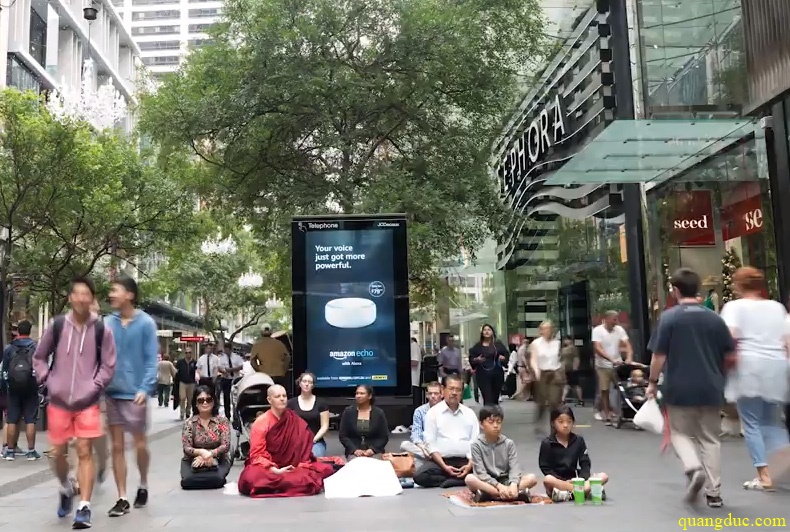
Street Meditation

22/12/201816:46(Xem: 5440)
Street Meditation

street meditation-gia hieu

Street Meditation

Gia Hiếu


Đọc được trên facebook của Ayya Yeshe, Sư cô viết: “….Peaceful sitting Meditation in the midst of The Christmas rush, just to show that another way is possible…”( Ngồi Thiền an tịnh trên đường phố, giữa mùa giáng sinh với nhiều hối hả, vội vàng là một cách để cho biết rằng vẫn có thể làm được…) Tôi thật sự cảm kích cái nhìn của một người tu sĩ, và là một Sư Cô người Úc, tu theo truyền thống Phật Giáo Mật Tông Tây Tạng, được biết Ayya Yeshe đã từng thực hiện những thời tu tập trên đường phố bận rộn tại New-York City và một vài nơi khác trên thế giới.

Thưa, tôi không nghĩ là mình có thể ngồi Thiền một cách an nhiên được giữa trung tâm thành phố Sydney, và giữa mùa giáng sinh thật sự bận rộn như hôm nay,(21.12.2018) tại 2 địa điểm, 1./ là đường hầm của Trạm xe lửa Central, và 2 là tại Pitt Street Mall -Sydney, nơi đây hàng ngàn người tấp nập lại qua, tiếng hòa nhạc với kèn trống vang rền, người người nói cười náo nhiệt, không khí Giáng Sinh tại Sydney thật sự tưng bừng đúng nghĩa của nó…và tôi chỉ việc theo Ayya Yeshe, ngồi xuống, xếp bằng, và nhắm mắt lại …ngồi thiền…

Mỗi thời khoảng 40 phút trôi qua thật nhanh và êm đềm một cách lạ kỳ, Thiên Ân hôm nay có được ngày nghĩ,đã đi cùng để chụp ảnh và làm Video Clip, nhờ vậy, tôi mới có dịp xem và biết được những gì đã diễn ra thật đẹp của thời tu thiền trên đường phố hôm nay. Xin chia sẻ cùng quý vị và các bạn một số hình ảnh và một video clip ngắn để tin rằng Ayya Yeshe nói đúng: “….Peaceful siting Meditation in the midst of The Christmas rust, just to show that another way is possible…” 

Gửi ý kiến của bạn
Tắt
Telex
VNI
Tên của bạn
Email của bạn
18/01/2011(Xem: 5300)
The following pages were originally intended as new sections to be added to the second edition of my introductory book on the Dhamma, What is Buddhism?. However, as many people are greatly interested in the practice of meditation, and as many are also separated from the sources of a living tradition, it is hoped that the following may be of value even apart from the sections of the book which they supplement.
18/01/2011(Xem: 6153)
There are lots of people who are ashamed to talk about their own defilements but who feel no shame at talking about the defilements of others. Those who are willing to report their own diseases -- their own defilements -- in a straightforward manner are few and far between. As a result, the disease of defilement is hushed up and kept secret, so that we don't realize how serious and widespread it is. We all suffer from it, and yet no one is open about it. No one is really interested in diagnosing his or her own defilements....
17/01/2011(Xem: 14286)
Bodhidharma (483-540 AD)
17/01/2011(Xem: 5338)
When you hear something about Buddhism in the daily news you usually think of it having a background of huge idols and yellow-robed monks, with a thick atmosphere of incense fumes. You never feel that there is anything in it for you, except, maybe, an exotic spectacle.
16/01/2011(Xem: 4889)
I want to talk in depth today about the nature of Buddhism. Very often I read in newspapers and books some strange things that are presented as Buddhism. So here, I will point out the heart of the real Buddhist teaching, not as a theory but as an experience.
14/01/2011(Xem: 5263)
At our meditation retreats, yogis practice mindfulness in four different postures. They practice mindfulness when walking, when standing, when sitting, and when lying down. They must sustain mindfulness at all times in whatever position they are in. The primary posture for mindfulness meditation is sitting with legs crossed, but because the human body cannot tolerate this position for many hours without changing, we alternate periods of sitting meditation with periods of walking meditation. Since walking meditation is very important, I would like to discuss its nature, its significance, and the benefits derived from its practice.
13/01/2011(Xem: 5658)
The object of Ch'an training is to realize the mind for the perception of (self-) nature, that is to wipe out the impurities which soil the mind so that the fundamental face of self-nature can really be perceived. Impurities are our false thinking and clinging (to things as real). Self-nature is the meritorious characteristic of the Tathagata wisdom which is the same in both Buddhas and living beings.
12/01/2011(Xem: 4879)
There are seven basic steps: 1. Start out with three or seven long in-&-out breaths, thinking bud- with the in-breath, and dho with the out. Keep the meditation syllable as long as the breath. 2. Be clearly aware of each in-&-out breath. 3. Observe the breath as it goes in & out, noticing whether it's comfortable or uncomfortable, broad or narrow, obstructed or free-flowing, fast or slow, short or long, warm or cool. If the breath doesn't feel comfortable, change it until it does. For instance, if breathing in long & out long is uncomfortable, try breathing in short & out short. As soon as you find that your breathing feels comfortable, let this comfortable breath sensation spread to the different parts of the body.
12/01/2011(Xem: 6114)
Unshakable deliverance of the mind is the highest goal in the Buddha's doctrine. Here, deliverance means: the freeing of the mind from all limitations, fetters, and bonds that tie it to the Wheel of Suffering, to the Circle of Rebirth. It means: the cleansing of the mind of all defilements that mar its purity; the removing of all obstacles that bar its progress from the mundane(lokiya) to the supramundane consciousness (lokuttara-citta), that is, to Arahatship.
11/01/2011(Xem: 4844)
The people are members of the Sangha of the Rio Grande Valley, a band of diverse people who meet, not always regularly, to meditate and discuss Eastern thought. Their common thread is Zen meditation and the pursuit of mindfulness. Mindfulness, the shift of focus to the present, is the path to a more peaceful living, members of the group say.
