
Breath, Way to Mindfulness
By Bhikkhu Thich Nguyen Tang
INTRODUCTION
It is my great pleasure to receive an invitation from the Senior Venerable Thich Nguyen Tang to write an introduction for his new book. I don’t think that my very poor introduction will be sufficient for his book. Perhaps it could be unfair to his great endeavor - better delete it. However, I take this opportunity to express my sincere gratitude towards him. I stayed in his monastery for a short time, during which time I was so well treated by him as his own monastery brother. I write this introduction very happily, even it is poor, to offer him a tribute. On one hand, I consider it as my great obligation and on the other hand it is my privilege.
“Breath, Way to Mindfulness” is a beautiful and attractive title given by Senior Venerable Thich Nguyen Tang for his new book. He is the Abbot of the Quang Duc Buddhist Monastery in Melbourne, Australia, and has written many books and Dharma articles with the great intention of propagating the Buddha’s noble teaching worldwide. This is another remarkable, outstanding and meaningful book, his 21st, which he presents for his valuable worldwide readers.
He is a prolific author having written many books and articles on many different subjects. This book is a collection of articles written by him upon various topics. The topics selected by the author are outstanding and deserve readers’ attraction. Presentation style of those articles is very simple, but the content is very profound. Mostly, all articles that have been written by the author are based on common and individual experiences that he had through events in his monastic life. One who reads these articles will experience ‘Bodhi Citta’ – the consciousness of enlightenment since that concept is emphasized in every article. Moreover, they show us author’s penetrative knowledge, wisdom, understanding, inner potentiality, positive energy and inner cultivation.
The letter of complaint to the National Gallery of Victoria shows us his bravery, steadfastness against, and intolerance of injustice. Furthermore, some articles, like ‘Nirvana is Eternal Peace’, reveal his philosophical and rational view as well as the vision and profound understanding of the Mahayana School. While other articles, like ‘A Tribute to Mother on Ullambana Day’, expose his sensitive and soft heart.
His faith and respect towards his beloved mother are commendable. Its narration is extremely beautiful. I strongly believe that all readers will be in touch with their heart while reading this very particular article. He has made an effort to bring forward the main historical and remarkable Buddhist characters of the monks (figures) who have done tremendous service for the blossoming of Buddhism. He has intended to introduce such great persons for the new generation of the Buddhist world through his writing.
He conveys a very clear message for the modern hectic society through his writing. The article, which was named as ‘Who could memorize the Sutra would be my husband’, is relevant for married life. This article presents the story in order to get the attention of the modern younger generation. Meanwhile, the author has made an effort to encourage the youth in to practicing Buddhism by giving the message that the one who cultivates Buddhism well, would be able to have a happy wedded life with a beautiful wife. ‘Buddhist View on Death and Rebirth’ and ‘Karma & Changing the Karma’ are two articles that are related to Buddhist philosophy (principle). These articles show his skill of explaining such a profound philosophical topic in a very simple and an appropriate way.
The relationship of the teacher and the disciple in the Buddhist monastic order is so important and significant. Though, the Buddha became enlightened by himself without any instructions of other teachers, he considered the noble Teaching as his teacher. Moreover, He advised his disciples to consider noble teaching as their own teacher, after his Great Parinibbana - Passing away. Buddhism evolved based on the lineage of the teachers and disciples. This is a strong link of both Theravada and Mahayana Buddhist tradition. The student, who is trained in this discipline, should respect the teacher in these ways:
(Pañcahi kho gahapatiputta ṭhānehi antevāsinā dakkhiṇā disā ācariyā paccupaṭṭhātabbā: uṭṭhānena, upaṭṭhānena, sussūsāya, pāricariyāya, sakkaccaṃ sippapaṭiggahaṇena)
- Cited from SingalovadaSutta)
By rising for them;
Regularly attending lessons;
Eagerly desiring to learn;
Duly serving them; and
Receiving instruction.
On the other hand, the teacher, who is trained in this school, should respect the student in these five ways:
(Pañcahi ṭhānehi antevāsiṃ anukampanti: suvinītaṃ vinenti, suggahitaṃ gāhāpenti, sabbasippasutaṃ samakkhāyino bhavanti, mittāmaccesu paṭiyādenti5, disāsuparittānaṃkaronti)
- Cited from SingalovadaSutta
By training in self-discipline;
Ensuring the teachings are well-grasped;
Instructing in every branch of knowledge;
Introducing their friends and colleagues; and
Providing safeguards in every direction.
Senior Venerable Thich Nguyen Tang has understood all those responsibilities and obligations very well, so that he has built up an extra-ordinary mutual relationship with his all teachers. The reason or secret behind his success is demonstrated in the article ‘In Memory of An Su’ which shows us his faith, respect, confidence, discipline and obedience developed by him towards his great teacher.
“Katau Katavedi Puggalo Dullabhasmi× loke" - "Grateful people are rare in the world". This is a great saying uttered by the Buddha. The article written by the author under the title of: ‘Thank you letter to former Prime Minister of Australia - Malcolm Fraser’, reveals his grateful thoughts and heart that he developed via this Buddhist discipline. He has embodied many great Buddhist qualities through his sincere practice. He is unselfish in a selfish world. Basically, people are selfish. It is human nature. One should practice a particular religion in order to overcome such an unhealthy attitude or thought. ‘Parttam Patipajjatha’ – to act for others’ success and wellbeing is a great human quality recommended by the Buddha. This is a great Buddhist norm. This great aspect of human nature is admired in both traditions of Theravada and Mahayana. Master Thich Nguyen Tang amply demonstrates this aspect through his noble behavior. Not only has he got that greatness with him, but also through his great writings he has revealed it.
Sabbadanam dhammadanam jinati
sabbarasam dhammaraso jinati
sabbaratim dhammarati jinati
tanhakkhayo sabbadukkham jinati.
(Dhammapada Verse 354)
The gift of the Dhamma excels all gifts; the taste of the Dhamma excels all tastes and delight in the Dhamma excels all delights. The eradication of craving (i.e., attainment of arahatship) overcomes all ills (samsara dukkha).
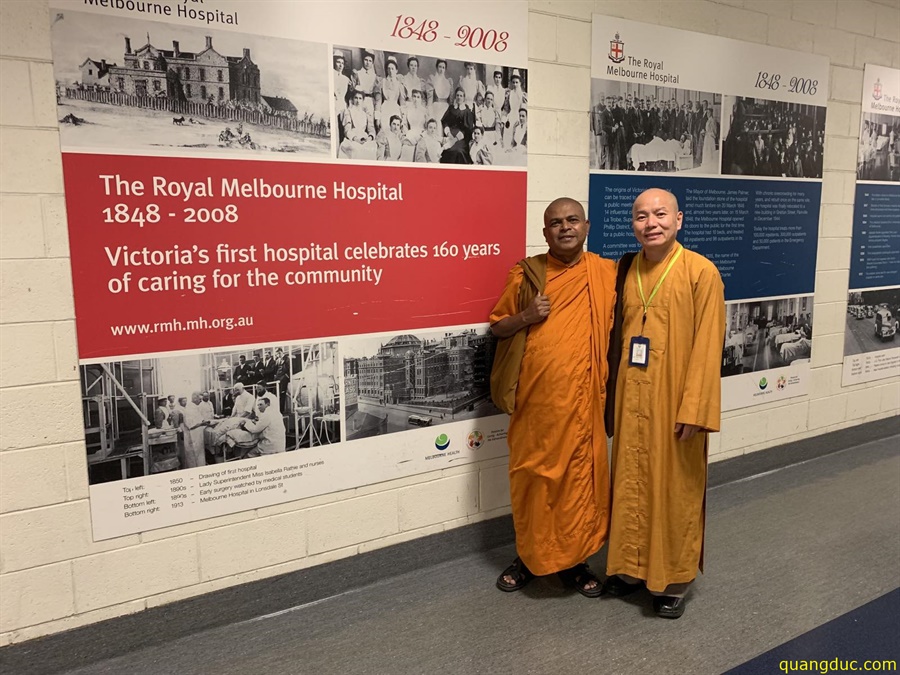
Most Ven. Dr. Bokanoruwe Dewananda
& Senior Venerable Thich Nguyen Tang
at Quang Duc Monastery, Melbourne, Australia
(This photo was taken on 20/02/2019)
The gift of the Dhamma is the greatest giving among the all other giving. The one who is well trained in the Dhamma will share his understanding of the Dhamma either by writing a book, by preaching Dhamma, by discussing Dhamma, or by writing an article. Master Thich Nguyen Tang has used all these methods in his contribution to the Dhamma. Giving food or cloth or any other material items to a person makes him happy and he indeed will survive in the world, but he cannot get rid of this terrible circle of birth and death. It can be done only by understanding the noble Dhamma. Thus, writing of the book is a great meritorious act as well as the great contribution for the Dhamma.
Master Thich Nguyen Tang contributes his positive energy, knowledge, wisdom, creativity, skill, thinking power and knowledge of modern technology for the sake of Buddhism in every possible way. He is the future of Buddhism. Therefore, I would like to wish him long life and good health. “May he obtain physical and mental peace, harmony, energy, and strength to keep on his noble service for booming of the Buddhist teaching worldwide”.
Most Ven. Dr. Bokanoruwe Dewananda
145/2B-Samaloka International Buddhist Centre
Godaparagahawatta Road
Talahena, Malabe. Sri-Lanka
E-mail: [email protected]


%7Cutmcsr%3D(direct)%7Cutmcmd%3D(none)%3B%2B__utmv%3D822767989.-%3B)