An Empty Vessel

03/05/202117:07(Xem: 10741)
An Empty Vessel

empty vessels

AN EMPTY VESSEL

By Ven. Shih Jingang


As a child my parents encouraged questions, as did my Heart Lama. However, the latter person gave me two questions to ask before speaking: “will what I am wanting to say, and the way I say it, be helpful or harmful to myself/others? Also, does the question come from ‘I don’t know’ (beginner’s mind), or from a place of judgement and opinions?” The aim was/is to cultivate the mind to be like an empty vessel, not one filled to the brim and overflowing where nothing new can enter.


Many years later, while studying to become a Chaplain, my Supervisor offered a gift in the form of a question, saying, “What is going on here?” As a Ch’an practitioner I took the question on as a Hua-t’ou, so that the light of inquiry was turned onto me and the whole experience of this moment. Whether sitting, standing, walking or lying down, I repeatedly asked, “What is going on here…?” It should be understood that I was not looking for an intellectual answer. It was going much deeper than just asking, “What is this thought, sensation, sound or external object?” In a more meaningful way, I was asking, “What is it that is thinking, feeling, hearing? What is it before thought?”


To this day the question remains alive in the pores of my skin and the marrow of my bones.  Wonderfully empty.
Namo Amitabha!


niem phat duong duc son (97)
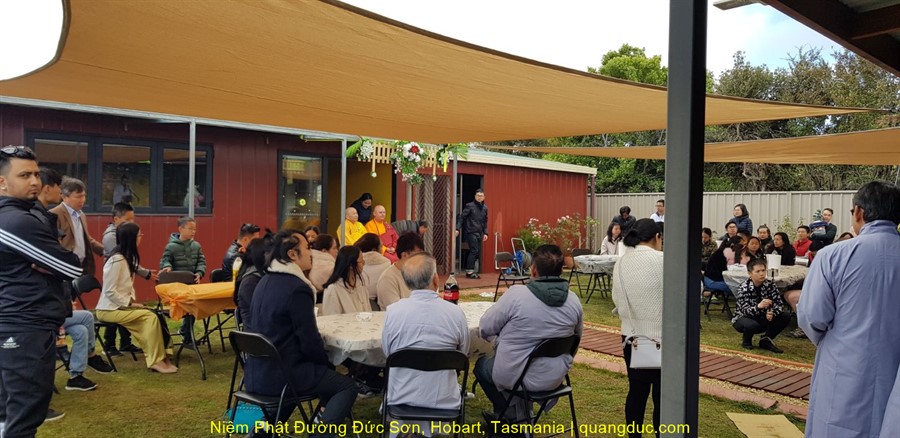
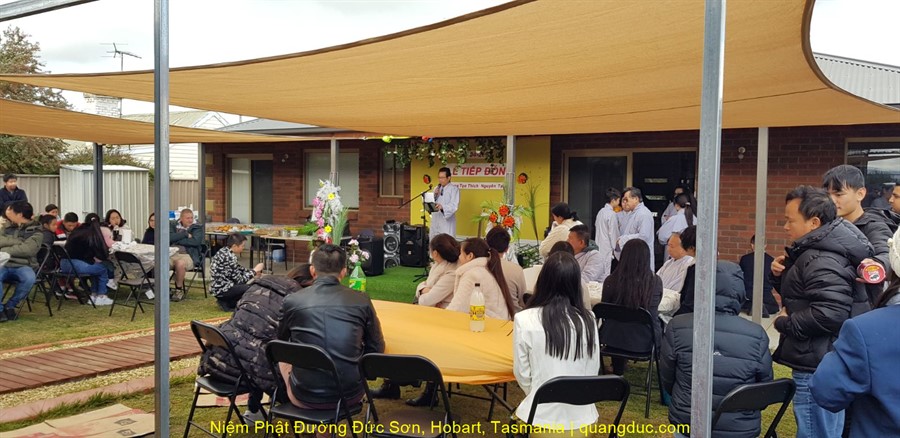
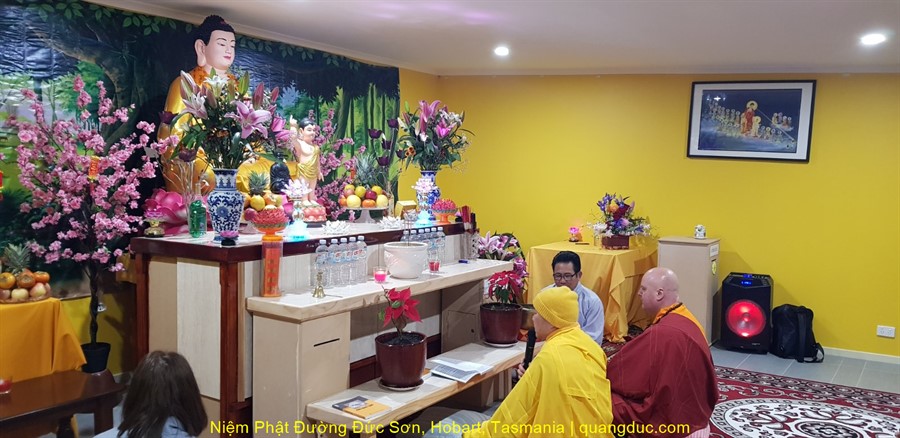
Ven Nguyen Tang & Ven Shil Jingang at Duc Son Buddhist Center, Bothwell, Tasmania (24/5/2021)
***

facebook-1


***
youtube
Gửi ý kiến của bạn
Tắt
Telex
VNI
Tên của bạn
Email của bạn
09/01/2017(Xem: 21575)
Every morning when I read the news, there are so many reports on war and destruction happening all over the world. This sometimes leads me to feel overwhelmed, helpless and somewhat guiltyfor the relatively peaceful life I have. How do Itransform these feelings of sadness, anger and helplessness into something a lot more productive and constructive?
30/12/2016(Xem: 14870)
1/ How does reincarnation work in Buddhism? 2/ When we pray who do we pray to? And the words we say when praying what do they mean? 3/ Have you ever been in love? 4/ In the future when treating patients how can I use Buddhism to help me? 5/ If good and bad are all relative to a person, let’s say, to a terrorist bomber, what they are doing is a good thing, but to others it is not. So that would mean right and wrong is relative too. So how do we know that something is an ‘absolute’ right thing who says that this is right and that is wrong. 6/ As a practising Buddhist lay person how can I reconcile my desire to be successful/ambitious/career-driven with the Buddhist concept of right livelihood. Sometimes it feels like the pursuit of being successful career-wise is very wordly, driven by materialism. Can I be a decent Buddhist AND a successful career person. Is this possible?
26/10/2016(Xem: 21068)
Seven Wonders of the Buddhist World | BBC Documentary | with English Subtitles, Over thirty years ago I sat and watched a programme on British television about Tutankhamen. I still remember the frisson - the realisation that the stories I'd heard; of boy-kings dripping in gold; of hidden burial chambers and court intrigue could, sometimes, be true. That BBC documentary was inspirational. I've been fortunate enough to spend my adult life following my own research interests - and delight in being able to share the results with a wider public.
01/10/2015(Xem: 11222)
Mindfulness Practice for Youths
14/05/2015(Xem: 29427)
Amitabha Buddha’s name chanting is an easy method of cultivation in which beliefs are difficult to have, especially in this age of information technology when people care more about material comfort than the spiritual life. However, as in the Buddha’s teachings: Buddhahood is a nature of mind and it’s the mind that possesses the Buddhahood, ringing about enlightenment. Therefore, as Buddhists, we have to believe in Buddha’s teachings. The Flower Adornment Sutra stated: “Beliefs are the mother of all the good merits.”. No other merits are greater than making a vow to be reborn in the Pure Land and to become a Buddha. On the occasion of this year’s retreat, we would like to briefly tell you about an old lady having a belief in Amitabha Buddha’s name chanting
21/11/2014(Xem: 27258)
As a Vietnamese Buddhist monk serving as a Buddhist chaplain in several hospitals across Melbourne, as well as at the Melbourne Assessment Prison, I have witnessed numerous personal tragedies experienced by the living, along with the profound realities of dying and death. Many individuals, especially those approaching the end of life, often face their final moments with fear, suffering, and deep emotional pain. Bearing these experiences in mind, I would like to share some reflections from a Buddhist perspective. It is my sincere hope that such understanding may help ease the fear surrounding death and allow individuals to approach this inevitable transition with greater calmness and acceptance. For, according to the Buddhist view, death is not the end of life, but rather a continuation within the cycle of existence.
24/03/2014(Xem: 4051)
No, Buddhism Is Not “Stupid,” Judge Tells Louisiana Teacher Read more: http://www.care2.com/causes/no-buddhism-is-not-stupid-judge-tells-louisiana-teacher.html#ixzz2wpaWYSUc
11/03/2014(Xem: 4164)
My friend Ashlee and I are best buddies. It was a really sad day for us when her Mom decided they would leave Santa Barbara and go to live in Utah. We met in Elementary School and were both in Junior High when she left. We kept in contact by email and phone. Her Dad lives in L. A., so she came back for Summer. Mom said Ashlee was welcome to spend a week with us.
11/03/2014(Xem: 4264)
Everything in the universe have three common properties: anicca, dukkha, and anatta. People, animals, things, towns, mountains, planets, stars, joy, money, knowledge, memories, everything you may imagine, everything you can't imagine. Every possible thing is anicca, dukkha, anatta. These three words are Pali words (Pali was the language spoken by the Buddha).
11/03/2014(Xem: 4105)
The word "buddhism" derives from "buddha". The one called "Buddha" is someone who has discovered nature of things as they are (among the whole of existing : life , universe, etc.) His was the only one able to understand completely and by himself all the life process: "Buddhism" is then Buddha's teaching, it is the way he suggests us to follow.