True Seeing (Ven. Shih Jingang)

03/05/202117:48(Xem: 16701)
True Seeing (Ven. Shih Jingang)
duc the ton 2

TRULY SEEING

By Ven. Shih Jingang


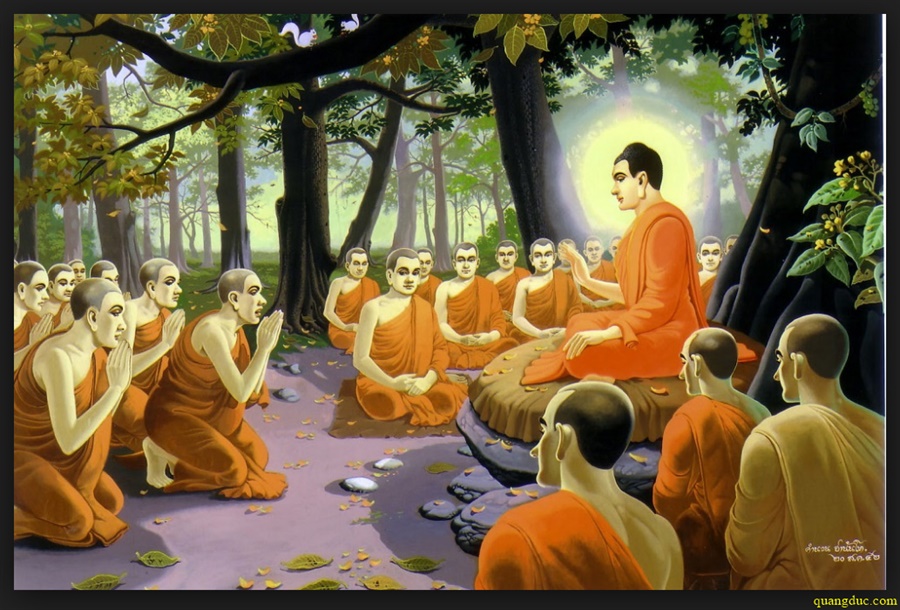
One day, while Little Pebble and his Master were walking through a garden, the old teacher stopped to look at a white rose in full bloom. He motioned for his young disciple to join him, and they both sat down near where the flower was growing.

   ‘Little Pebble,’ said the Master, ‘when you look at this object, tell me what you think about it.’

   ‘The flower is pretty,’ stated the boy. ‘I like it.’

   ‘’’Flower,” you say. “Pretty, like it,” you say,’ replied the Master, looking to see how his young disciple reacted. Then he added, ‘Mind creates names like flower, and thoughts of like and dislike, pretty and ugly. This mind is small and closed, but if you can see beyond it to the nature of mind, then all is vast like space, completely open to all things. In this state of awareness, there is neither a flower nor a non-flower. Understand?’

   But the young disciple did not quite understand, so his Master continued, ‘Little one, come here each day, and observe this flower. It will be your teacher. Watch it closely, then show me what its teaching is. OK?’

   Little Pebble did exactly as he was told and returned each day to closely observe the flower in the garden. As time passed by, the white petals of the rose slowly began to change colour and shape as it decayed and eventually died.

   During this process, something was also changing within Little Pebble as he witnessed the natural cycle of decay and death, which helped him to appreciate the short-lived fragility of the flower. At first he perceived the flower as beautiful, and its death as ugly. Then he saw the fragility of the flower as ugly, and great beauty in its death. Finally he realised that every stage in the life cycle of the flower was neither beautiful nor ugly. This awareness extended to


                                                                                                            2


seeing the flower, himself, and all other beings in a constant state of change: birth, the fullness of life, decay, death and rebirth. He saw the natural world around and within himself, as if for the first time, interconnected and interdependent in countless ways.

   When the young disciple eventually returned to his Master, the old monk could tell that something had changed in him. ‘Oh!’ exclaimed the Master, ‘I see that the flower is a great teacher,’ and he bowed respectfully in the direction of the garden.

   Little Pebble followed his example.


~Extract from the book, A Sparrow Splashing, by Shih Jingang. Published by Ginninderra Press.


niem phat duong duc son (32)
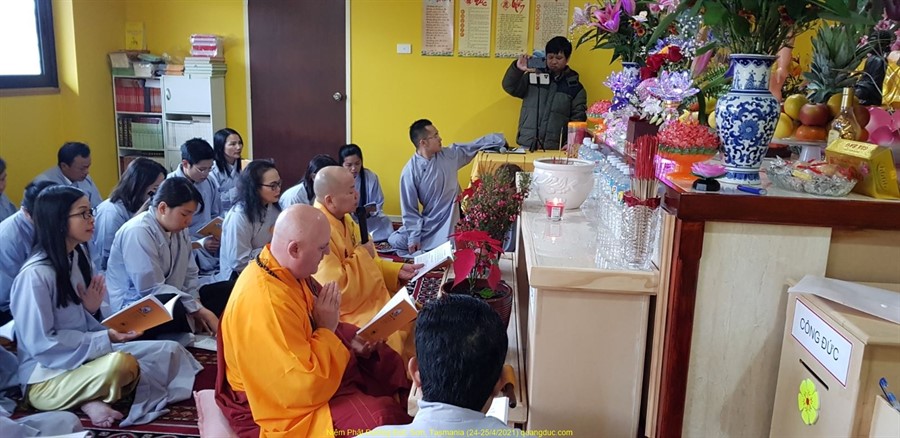
Ven Nguyen Tang & Ven Shil Jingang at Duc Son Buddhist Center, Bothwell, Tasmania (24/5/2021)


***
youtube
Gửi ý kiến của bạn
Tắt
Telex
VNI
Tên của bạn
Email của bạn
30/03/2023(Xem: 9912)
War - we all know this word. There were too many battles in this world since we were the nomads, wandering over sea and land up to the time when the acquisition of material goods increased over time and possession became more powerful in their desire to master and dominate the world. In family and society, from the young to the dignitary, none of them want to give up possession but always to get more. The more assets, the greater desire. The more one tries to get, the stronger greed and selfishness fortifies.
14/01/2023(Xem: 22368)
Lunar New Year 2023 Festival at Quang Duc Monastery, Fawkner, Victoria, Australia
15/06/2022(Xem: 9462)
The story of the murder of a law ex-student named Raskolnikov is told in Dostoevsky’s “Crime and Punishment”. After suppressing his crime for several days in tremendous agony and terrible suffering in his conscience, Raskolnikov resolved to confess his wrongdoing to his companion, Sonia. In his confession, Raskolnikov reveals some motives for his crime, but he does not explain exactly why the elderly woman ought to be murdered. The tale then presents a mystery, a crime, as a result of Raskolnikov’s predestination. The purpose of this article is to prove that the motive of Raskolnikov’s crime is not his destiny, but rooted in his mind.
07/08/2021(Xem: 21272)
The Eight Precepts with Right Livelihood as the Eighth (Ājīvatthamaka Sīla) Dhamma Teachers Certificate EN074 -__ Feb2010 5 8 Precepts Diacritials Requirements and Ceremonies for the Five Precepts (Panca Sila), The Eight Precepts with Right Livelihood as the Eighth (Ajivatthamaka Sila), Dhamma Teachers Certificate, issued by the Buddhist Group of Kendal (Theravada) and Ketumati Buddhist Vihara at Wesak 2006). Updated February 2010
07/08/2021(Xem: 15572)
Venerable Rewata Dhamma born in Myanmar [Burma], was head of the Birmingham Buddhist Vihara until his death in 2004. His book Maha Paritta: The Discourses of the Great Protection (With the Threefold Refuges, Precepts, Salutations to the Triple Gem, Dependent Origination and Metta Bhavana), gives the formula in Pali and English for requesting Ajivatthamaka Sila (The Eight Precepts with Right Livelihood as the Eighth). (pages 9-12) Venerable Balangoda Ananda Maitreya Mahanayaka Thera Abhidhaja Maharatthaguru Agga Maha Pandita (1896-1998) Venerable Balangoda Ananda Maitreya, born in Sri Lanka, attended the Sixth Buddhist Council held in Myanmar [Burma] (1954-56). In 1956, during the third session of the Council, he served as Chairman of the Convocation for a few weeks. The Council was convened by the Myanmar [Burmese] government to prepare an authorized re-edit and reprint of the entire Tipitaka (the Pali Canon) and its commentaries. Venerable Ananda Maitreya was appointed the Sri
07/08/2021(Xem: 18886)
The BEP Buddhist Embroidery Project was started by attendees of the London Buddhist Vihara (Monastery) in 1994. The BEP decided to teach embroidery to people who had not learnt it in childhood. The late Venerable Apparakke Jinaratana, a Theravada Buddhist Bhikkhu (monk), who lived in a cave in Sri Lanka, near a very poor village, was using very old newspapers (supplied by villagers) as tablecloths. The BEP decided to embroider tablecloths, wall hangings and sitting cloths for his use. Although items are given to one monk, they actually belong to the whole of the Bhikkhu Sangha [Order of Buddhist Monks] according to the Vinaya (Buddhist Monastic Discipline). In Asian villages, washing is done in streams and waterfalls, and hung to dry in the hot sun, so items do not last as long as they do in the west.
30/07/2021(Xem: 10706)
Introducing Buddhism by Venerable Dr Balangoda Ananda Maitreya Mahanayaka Thera Abhidhaja Maharatthaguru Aggamaha Pandita DLitt DLitt (1896-1998) and Jacquetta Gomes Bodhicarini Upasika Jayasili. Introducing Buddhism was originally published by The Buddhist Society London in 1988, to accompany The Buddhist Society’s Introducing Buddhism Course, on which Jacquetta Gomes was one of the teachers. Introducing Buddhism has subsequently been published by Buddhist organisations in England, Sri Lanka, Malaysia, Taiwan, and the USA. Introducing Buddhism is available on several websites including Access to Insight, CBE Chinese Buddhist Encyclopedia and Google Books. Introducing Buddhism was launched by the BCC Buddhist Cultural Centre in Sri Lanka with 24 other books under the patronage of Venerable Dr K. Sri Dhammananda Chief Sangha Nayaka of Malaysia and Singapore, in December 1997.
09/06/2021(Xem: 15789)
Cuộc Đời Của Người Tăng Sĩ Das Leben eines buddhistischen Mönches Tác giả: HT Thích Bảo Lạc & HT Thích Như Điển Chuyển ngữ: Nguyễn Ngọc Tuấn & Nguyễn Thị Thu Cúc
03/05/2021(Xem: 15373)
As a child, my mother Enid often said to me, “There is no such thing as a silly question,” and then would add, “unless.” This latter word was left hanging, and I eventually realised that it was up to me to learn the depth of its meaning. At the same time that Enid was planting seeds for reflection, my first spiritual teacher, Ven. Lama Senge Tashi, encouraged me to cultivate more skilful thoughts, speech and actions. Sometimes I would try to verbally assert “I” or “Me,” and Lama would respond with, “Who is speaking?” or “Who is asking?”
03/05/2021(Xem: 15083)
During the Covid-19 pandemic a dharma sister passed from this life. Her name was Robyn. Although she did not call herself a Buddhist, nevertheless, Robyn had a special connection with the deity Medicine Buddha. Over the six years that I worked with her, in my role as a hospital chaplain, Robyn frequently asked me to chant the mantra of Medicine Buddha and guide her through the visualisation. During her many stays in hospital, this particular practice brought comfort to her while she was experiencing chronic pain, anxiety and fear of the unknown. The medications she took would sometimes cloud her memory, so I would guide her through the details of the visualisation and begin chanting:
