
Flying Practice

03/05/202117:25(Xem: 12425)
Flying Practice

qantas

FLYING PRACTICE

By Ven. Shih Jingang


Today I sit alone in a house. The government of the country in which I live has requested that I stay here in isolation for the health and safety of the community both here and abroad. Countless others are doing the same thing, except that some call it a forced lock down, or an obstacle to their free movement.  I see this as an opportunity to practice.


The Buddha taught that  the suffering connected with birth, sickness, old age and death is a fact of life for sentient beings in Samsara. But so is the possibility of transcendence from Samsaric suffering. 


So, for a practitioner, the question is not just “Why?” but also “How?”  Why do I/we suffer and, how  do I/we overcome suffering?  The answer to  the former is found in intuitively recognizing (the 3 Poisons): harmful habits of attachment, anger and ignorance; and the answer to the latter lies in resolving to study and practice the Noble Eightfold Path (the antidote) and, fully realizing Buddhahood for the benefit of all sentient beings.


At the heart of the Bodhisattva path is Compassion and  Wisdom in perfect balance.  It must be, for a bird needs two wings to be able to fly.


These are challenging times for many. At this moment, how do you feel? Like a bird trapped in a cage, or do you see this as an opportunity to learn how to fly?
The choice is yours.    
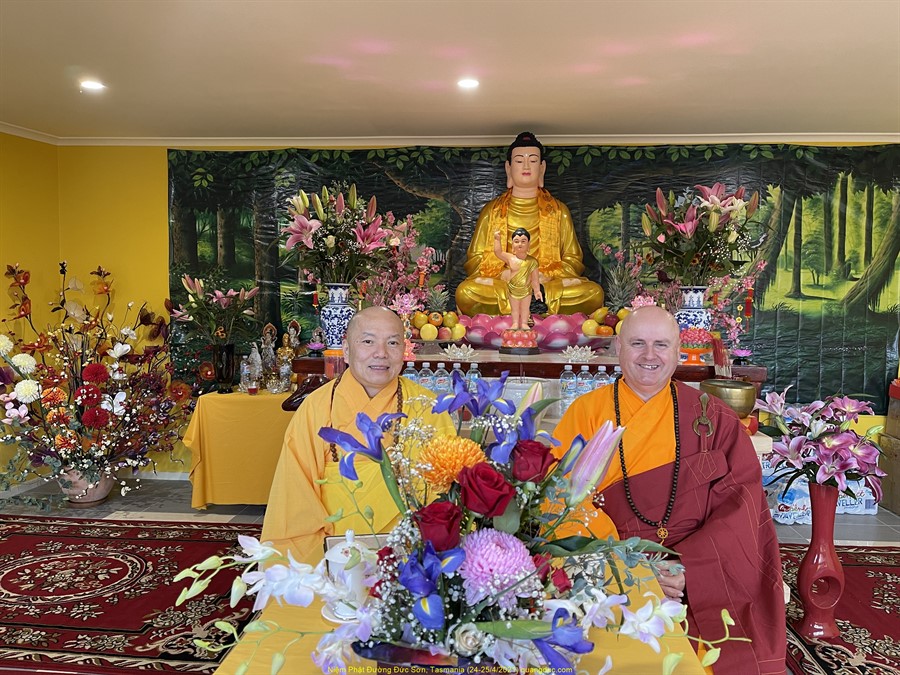


niem phat duong duc son (30)
Ven Nguyen Tang & Ven Shil Jingang at Duc Son Buddhist Center, Bothwell, Tasmania (24/5/2021)


***
youtube


Gửi ý kiến của bạn
Tắt
Telex
VNI
Tên của bạn
Email của bạn
01/10/2015(Xem: 11200)
Mindfulness Practice for Youths
24/05/2015(Xem: 13705)
Bhikkhu Bodhi is an American Buddhist monk from New York City. Born in Brooklyn, New York, in 1944, he obtained a BA in philosophy from Brooklyn College (1966) and a PhD in philosophy from Claremont Graduate School (1972).
24/05/2015(Xem: 13924)
Bhikkhu Bodhi - The Essence of Buddhism - YouTube
22/05/2015(Xem: 55305)
Audio: Thập Bát La Hán, bài giảng của Thầy Nguyên Tạng tại Chùa Linh Sơn, Detroid, Michigan, USA
01/04/2015(Xem: 12811)
Vesak festival at Melbourne city, 23-4-2015
24/03/2015(Xem: 17306)
The ASA annual conference brings together Buddhist monastics of all traditions living in, or visiting Australia, for fellowship, dialogue and to address the issues facing Buddhism in Australia. The ASA has in previous years, and is still working with the Department of Immigration & Border Security to assist those monastic’s seeking Permanent Residency Visas through representations to the Federal Government. Where appropriate, the ASA has and continues to consult with state Buddhist Councils and Federation of Australian Buddhist Councils (FABC) for a solution to these ongoing issues. The ASA has arranged monastic education forums such as the 2010 Vinaya Conference, and represents the Australian Sangha community at various International Conferences, as well as consultations with various State & Federal Government agencies.
08/02/2015(Xem: 8390)
Wake Up – Young Adults for a Healthy and Compassionate Society, is a world-wide network of young people practicing the living art of mindfulness. We share a determination to live in an awakened way, taking a 21st Century version of the 5 Mindfulness Trainings as our path and guiding light. The Wake Up network has grown out of Plum Village meditation center in SW France, under the guidance of Venerable Zen Master Thich Nhat Hanh. Plum Village has been offering retreats to young people for over two decades, and the Wake Up movement was formally launched in Summer 2008.
21/11/2014(Xem: 7885)
The first two steps in the process of becoming a lay disciple of the Buddha are the going for refuge (sarana gamana) and the undertaking of the five precepts (pañca-sila samadana). By the former step a person makes the commitment to accept the Triple Gem — the Buddha, the Dhamma, and the Sangha — as the guiding ideals of his life, by the latter he expresses his determination to bring his actions into harmony with these ideals through right conduct. The following two tracts were written for the purpose of giving a clear and concise explanation of these two steps. Though they are intended principally for those who have newly embraced the Buddha's teaching they will probably be found useful as well by long-term traditional Buddhists wanting to understand the meaning of practices with which they are already familiar and also by those who want to know what becoming a Buddhist involves.
21/11/2014(Xem: 27237)
As a Vietnamese Buddhist monk serving as a Buddhist chaplain in several hospitals across Melbourne, as well as at the Melbourne Assessment Prison, I have witnessed numerous personal tragedies experienced by the living, along with the profound realities of dying and death. Many individuals, especially those approaching the end of life, often face their final moments with fear, suffering, and deep emotional pain. Bearing these experiences in mind, I would like to share some reflections from a Buddhist perspective. It is my sincere hope that such understanding may help ease the fear surrounding death and allow individuals to approach this inevitable transition with greater calmness and acceptance. For, according to the Buddhist view, death is not the end of life, but rather a continuation within the cycle of existence.
24/10/2014(Xem: 8511)
Shang Rinpoche is a highly esteemed Buddhist master from Taiwan. In teaching, he not only draws on his Buddhist wisdom, but also his extensive knowledge of Taoism, eastern history and philosophy. Rinpoche’s mix of humour, kindness, and compassion has given strength and inspiration to thousands of people from all walks of life. Rinpoche is the current incarnation of Shang Rinpoche, who founded the Tsalpa Kagyu school in Tibet in the 13th Century. His root master is the current incarnation of the Great Terton Dorje Lingpa. In addition, Rinpoche has received pith instructions as well as lineages from some of the greatest masters of all four Vajrayana schools including Dilgo Kysentse, Chatral Rinpoche, Dudjom Rinpoche and the 16th Karmapa. Rinpoche has also received the lineage of great Chan (Chinese Zen) Master Empty Cloud (虛雲老和尚) as well as teachings & lineages from Master Huisan (慧三老和尚) and Master Jiede (戒德老和尚).
