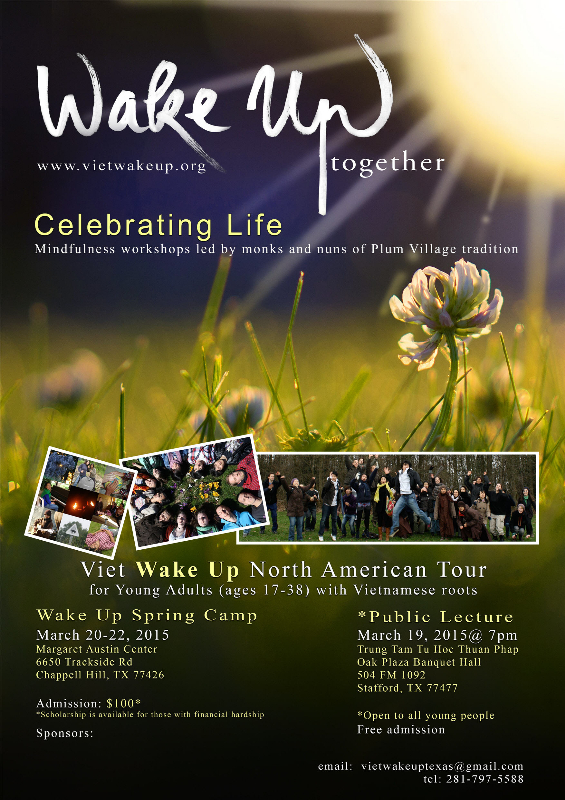
Wake Up – Young Practitioners
Wake Up – Young Adults for a Healthy and Compassionate Society, is a world-wide network of young people practicing the living art of mindfulness. We share a determination to live in an awakened way, taking a 21st Century version of the 5 Mindfulness Trainings as our path and guiding light.
The Wake Up network has grown out of Plum Village meditation center in SW France, under the guidance of Venerable Zen Master Thich Nhat Hanh. Plum Village has been offering retreats to young people for over two decades, and the Wake Up movement was formally launched in Summer 2008.
Young monks, nuns and young lay people of many different nationalities help co-ordinate groups and events from Plum Village practice centers all over the world – Deer Park monastery in California, Blue Cliff monastery in New York, La Maison de L’Inspir’ in Paris, the European Institute for Applied Buddhism in Germany, and Thai Plum Village (in Thailand).
We want to help our world which is overloaded with intolerance, discrimination, craving, anger and despair. Seeing the environmental degradation caused by our society, we want to live in such a way that our planet Earth can survive for a long time. Practicing mindfulness, concentration and insight, enables us to cultivate tolerance, non-discrimination, understanding and compassion in ourselves and the world.
We are of all nationalities and of all faiths – or none. We don’t ‘believe’ blindly in the Buddha’s teachings on mindfulness; we each experience that they do just work. When we practice mindful walking, breathing, smiling, sitting, eating, talking, listening and hanging-out together, we experience happiness and peace – a kind of oasis of relief from the junk of life. At last we have a chance to live more deeply, happily and meaningfully. There is joy, relief and healing.
We know that by getting together for an evening, weekend or short retreat, we can create a strong collective energy of mindfulness that can nourish our joy, heal our pains, and develop our understanding and love. We also support each other online – through this website, email and through groups on The Book. In this way we help each other to realize our ideal of transforming and healing ourselves and the world.
The Wake Up network is also just very spontaneous and self-seeding – nobody needs to permission to start a group, you can just do it! There are different styles of get-togethers and groups depending on whatever feels like a natural way to hang out together and practice mindfulness – we’ve all been very creative so far and encourage you to be free-thinking too. To get some ideas about what you can do, please read our article on how to get involved.

Practice: essence
We follow the Five Mindfulness Trainings, which are ethical guidelines that offer concrete practices of true love and compassion, and a path towards a life in harmony with each other and the Earth. These guidelines are the foundation of our lives and represent our ideal of service. Our practice is based on cultivating awareness of the breath and living deeply in the present moment, aware of what is happening within us and around us. This practice helps us to release the tension in our bodies and feelings, to live life deeply and more happily, and to use compassionate listening and loving speech to help restore communication and reconcile with others.
Roots/Inclusiveness
The Wake Up movement is inspired by Buddhism’s long tradition of wisdom and practices which help cultivate understanding and love; it is not based on beliefs or ideology. The spirit of our practice is close to the spirit of science; both help us cultivate an open and non-discriminating mind. We honor everyone’s diverse spiritual and cultural roots. You can join as a Christian, a Jew, a Muslim, as an agnostic or atheist, or member of any other spiritual or religious tradition.
What we do
We aspire to be a place of refuge, nourishment and support for anyone with an aspiration to transform their own suffering and contribute to a healthy and compassionate society. We gather weekly or monthly in Wake Up groups to practice sitting and walking meditation, to listen to a teaching, practice total relaxation, listen deeply to one another, and recite the Five Mindfulness Trainings. We also organize mindfulness events and retreats, and visit meditation practice centers together to refresh ourselves and strengthen our practice. Many groups also organize music evenings, meditation flash mobs, picnics, hikes and other special events or actions.
You can do it
If you are a young person inspired to cultivate mindfulness and compassion in your life, we invite you to join the Wake Up movement in your country. Wake Up offers a way to pool our energy and act collectively, to create the world we want to live in! Anyone can get together and form a Wake Up group wherever they are. Please let us know what you are planning to do and what you are trying to achieve. We will do our best to support you.
The First Mindfulness Training: Reverence For Life
Aware of the suffering caused by the destruction of life, I am committed to cultivating the insight of interbeing and compassion and learning ways to protect the lives of people, animals, plants, and minerals. I am determined not to kill, not to let others kill, and not to support any act of killing in the world, in my thinking, or in my way of life. Seeing that harmful actions arise from anger, fear, greed, and intolerance, which in turn come from dualistic and discriminative thinking, I will cultivate openness, non-discrimination, and non-attachment to views in order to transform violence, fanaticism, and dogmatism in myself and in the world.
The Second Mindfulness Training: True Happiness
Aware of the suffering caused by exploitation, social injustice, stealing, and oppression, I am committed to practicing generosity in my thinking, speaking, and acting. I am determined not to steal and not to possess anything that should belong to others; and I will share my time, energy, and material resources with those who are in need. I will practice looking deeply to see that the happiness and suffering of others are not separate from my own happiness and suffering; that true happiness is not possible without understanding and compassion; and that running after wealth, fame, power and sensual pleasures can bring much suffering and despair. I am aware that happiness depends on my mental attitude and not on external conditions, and that I can live happily in the present moment simply by remembering that I already have more than enough conditions to be happy. I am committed to practicing Right Livelihood so that I can help reduce the suffering of living beings on Earth and reverse the process of global warming.
The Third Mindfulness Training: True Love
Aware of the suffering caused by sexual misconduct, I am committed to cultivating responsibility and learning ways to protect the safety and integrity of individuals, couples, families, and society. Knowing that sexual desire is not love, and that sexual activity motivated by craving always harms myself as well as others, I am determined not to engage in sexual relations without true love and a deep, long-term commitment made known to my family and friends. I will do everything in my power to protect children from sexual abuse and to prevent couples and families from being broken by sexual misconduct. Seeing that body and mind are one, I am committed to learning appropriate ways to take care of my sexual energy and cultivating loving kindness, compassion, joy and inclusiveness – which are the four basic elements of true love – for my greater happiness and the greater happiness of others. Practicing true love, we know that we will continue beautifully into the future.
The Fourth Mindfulness Training: Loving Speech and Deep Listening
Aware of the suffering caused by unmindful speech and the inability to listen to others, I am committed to cultivating loving speech and compassionate listening in order to relieve suffering and to promote reconciliation and peace in myself and among other people, ethnic and religious groups, and nations. Knowing that words can create happiness or suffering, I am committed to speaking truthfully using words that inspire confidence, joy, and hope. When anger is manifesting in me, I am determined not to speak. I will practice mindful breathing and walking in order to recognize and to look deeply into my anger. I know that the roots of anger can be found in my wrong perceptions and lack of understanding of the suffering in myself and in the other person. I will speak and listen in a way that can help myself and the other person to transform suffering and see the way out of difficult situations. I am determined not to spread news that I do not know to be certain and not to utter words that can cause division or discord. I will practice Right Diligence to nourish my capacity for understanding, love, joy, and inclusiveness, and gradually transform anger, violence, and fear that lie deep in my consciousness.
The Fifth Mindfulness Training: Nourishment and Healing
Aware of the suffering caused by unmindful consumption, I am committed to cultivating good health, both physical and mental, for myself, my family, and my society by practicing mindful eating, drinking, and consuming. I will practice looking deeply into how I consume the Four Kinds of Nutriments, namely edible foods, sense impressions, volition, and consciousness. I am determined not to gamble, or to use alcohol, drugs, or any other products which contain toxins, such as certain websites, electronic games, TV programs, films, magazines, books, and conversations. I will practice coming back to the present moment to be in touch with the refreshing, healing and nourishing elements in me and around me, not letting regrets and sorrow drag me back into the past nor letting anxieties, fear, or craving pull me out of the present moment. I am determined not to try to cover up loneliness, anxiety, or other suffering by losing myself in consumption. I will contemplate interbeing and consume in a way that preserves peace, joy, and well-being in my body and consciousness, and in the collective body and consciousness of my family, my society and the Earth.
Beginning Anew
To begin anew is to look deeply and honestly at ourselves, our past actions, speech and thoughts and to create a fresh beginning within ourselves and in our relationships with others. At the practice center we practice Beginning Anew as a community every two weeks and individually as often as we like.
We practice Beginning Anew to clear our mind and keep our practice fresh. When a difficulty arises in our relationships with fellow practitioners and one of us feels resentment or hurt, we know it is time to Begin Anew. The following is a description of the four-part process of Beginning Anew as used in a formal setting. One person speaks at a time and is not interrupted during his or her turn. The other practitioners practice deep listening and following their breath.
1) Flower watering - This is a chance to share our appreciation for the other person. We may mention specific instances that the other person said or did something that we had admired. This is an opportunity to shine light on the other’s strengths and contributions to the sangha and to encourage the growth of his or her positive qualities.
2) Sharing regrets - We may mention any unskillfulness in our actions, speech or thoughts that we have not yet had an opportunity to apologize for.
3) Expressing a hurt - We may share how we felt hurt by an interaction with another practitioner, due to his or her actions, speech or thoughts. (To express a hurt we should first water the other person’s flower by sharing two positive qualities that we have trully observed in him or her. Expressing a hurt is often performed one on one with another practitioner rather than in the group setting. You may ask for a third party that you both trust and respect to be present, if desired.)
4) Sharing a long-term difficulty & asking for support- At times we each have difficulties and pain arise from our past that surface in the present. When we share an issue that we are dealing with we can let the people around us understand us better and offer the support that we really need.
The practice of Beginning Anew helps us develop our kind speech and compassionate listening. Begin Anew is a practice of recognition and appreciation of the positive elements within our Sangha. For instance, we may notice that our roommate is generous in sharing her insights, and another friend is caring towards plants. Recognizing others positive traits allows us to see our own good qualities as well.
Along with these good traits, we each have areas of weakness, such as talking out of our anger or being caught in our misperceptions. When we practice “flower watering” we support the development of good qualities in each other and at the same time we help to weaken the difficulties in the other person. As in a garden, when we “water the flowers” of loving kindness and compassion in each other, we also take energy away from the weeds of anger, jealousy and misperception.
We can practice Beginning Anew everyday by expressing our appreciation for our fellow practitioners and apologizing right away when we do or say something that hurts them. We can politely let others know when we have been hurt as well. The health and happiness of the whole community depends on the harmony, peace and joy that exists between every member in the sangha.

%7Cutmcsr%3D(direct)%7Cutmcmd%3D(none)%3B%2B__utmv%3D527588989.-%3B)